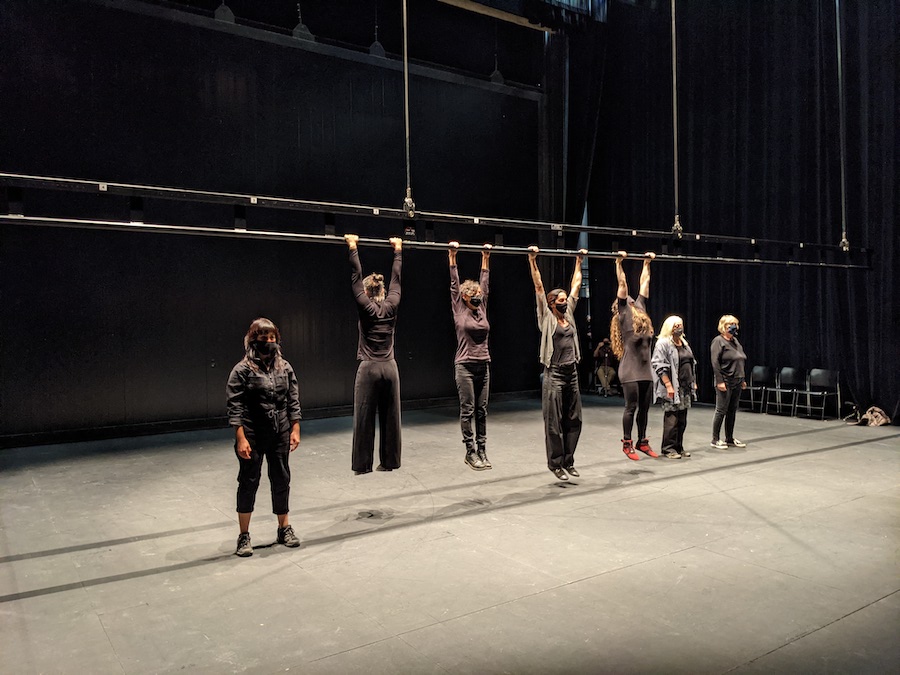
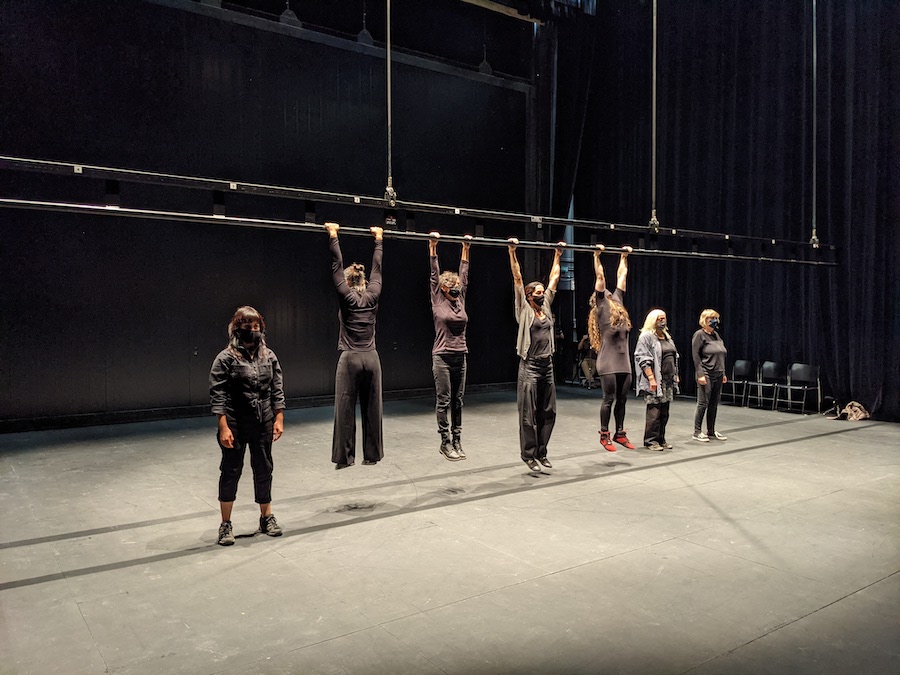
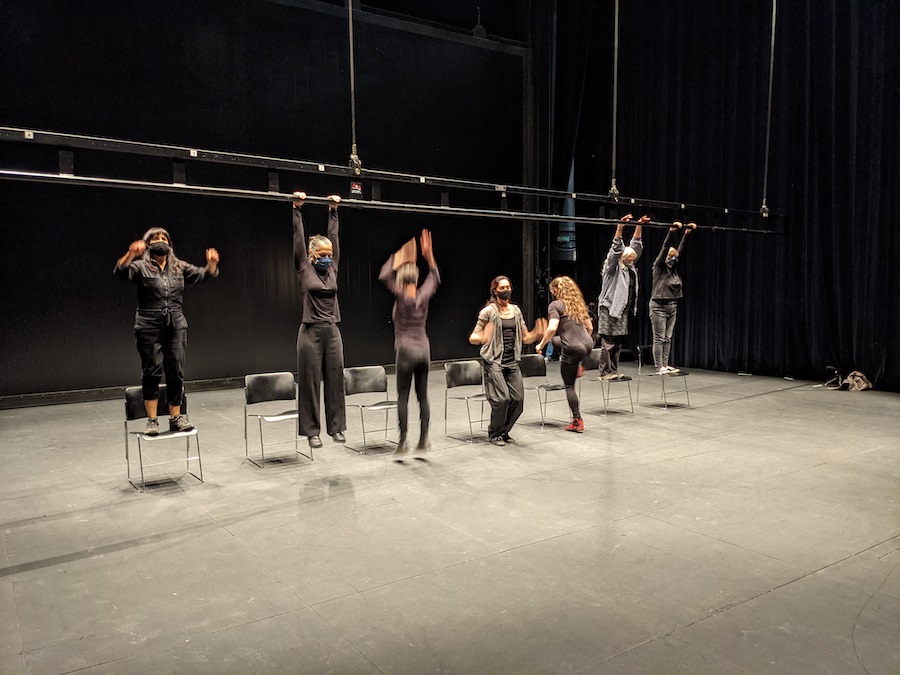
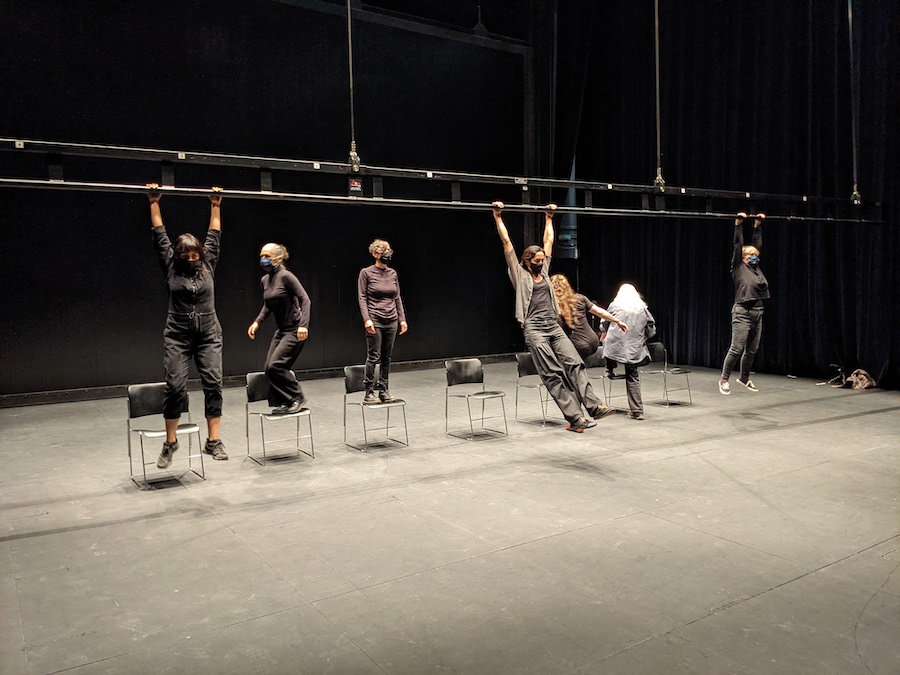
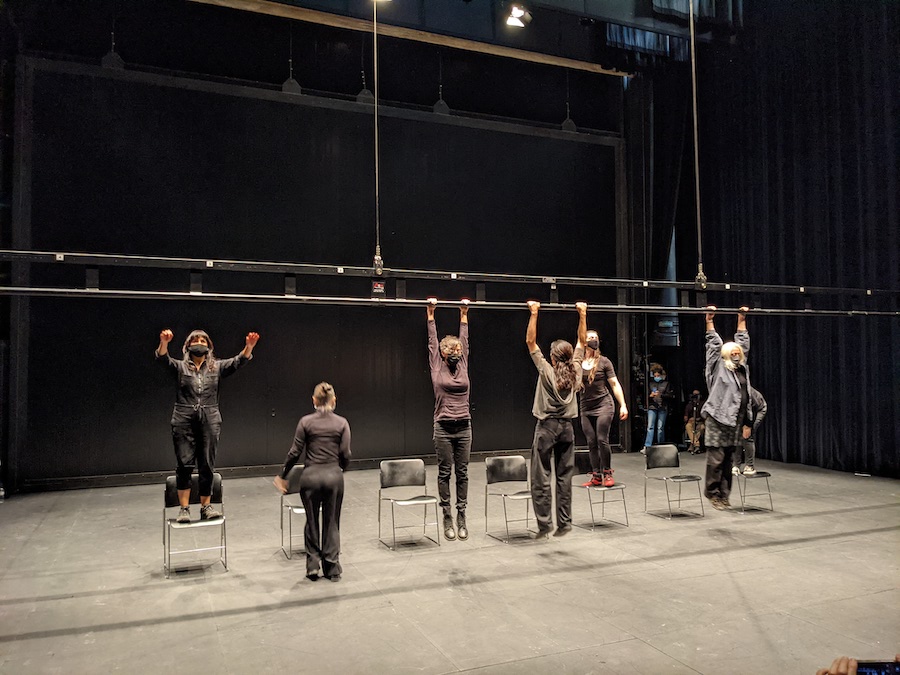
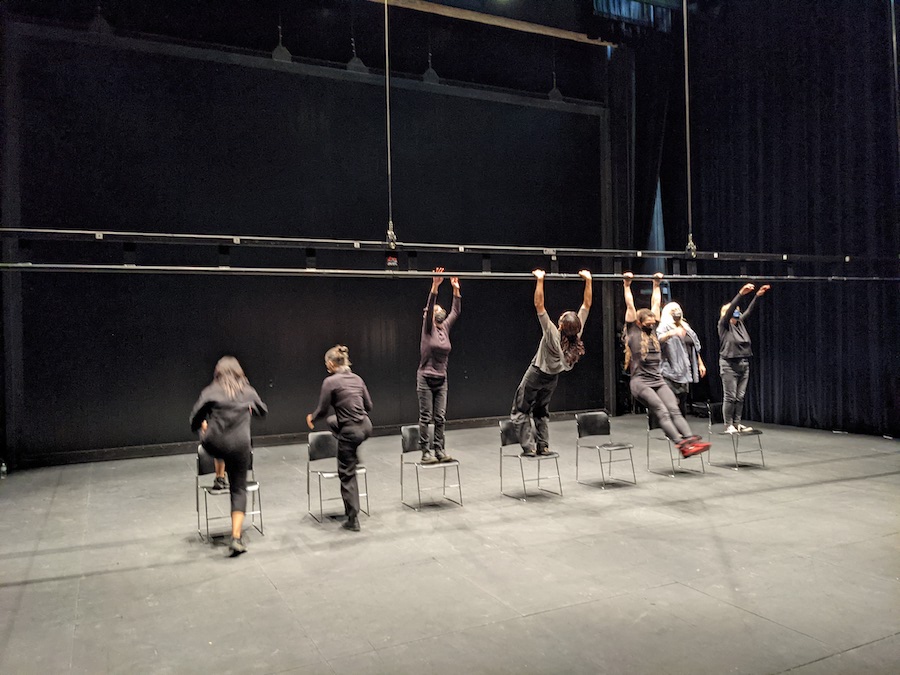
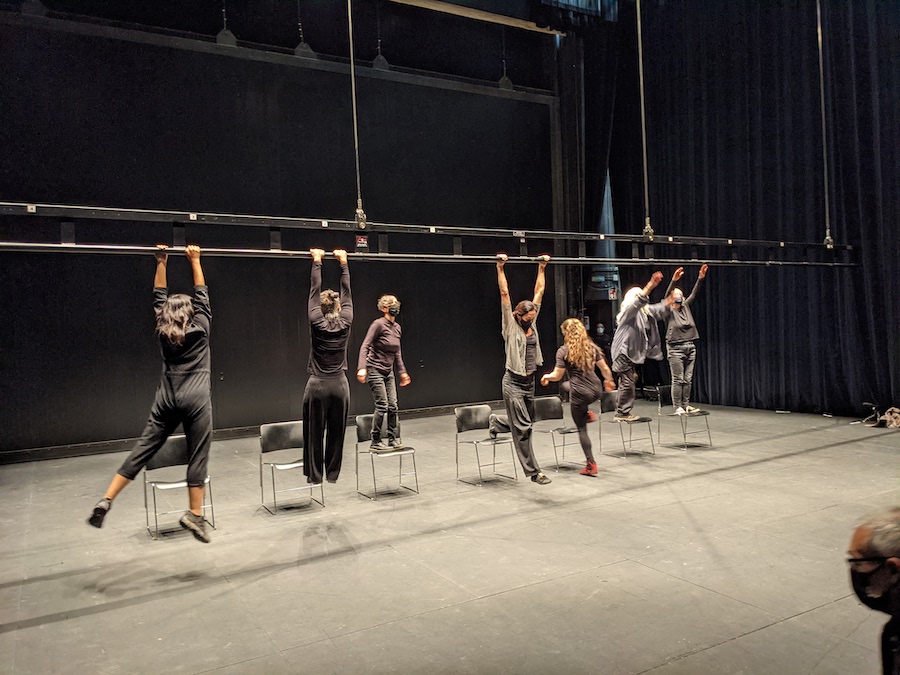
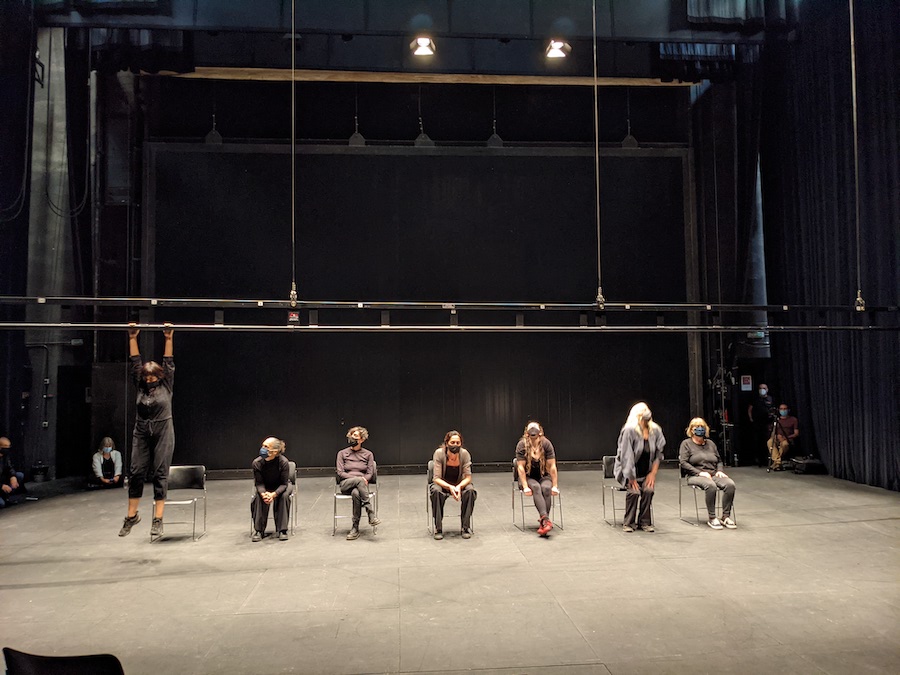
We Are Not Alone – 2025

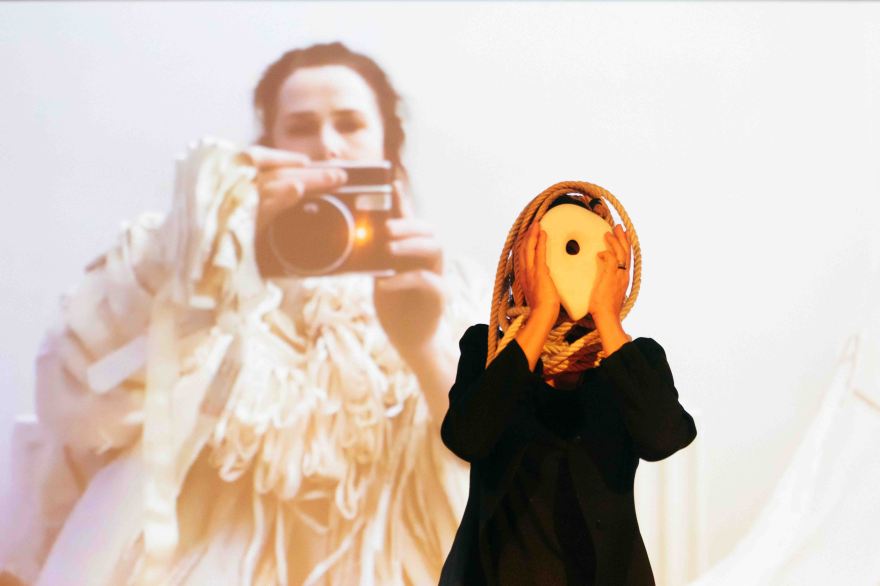
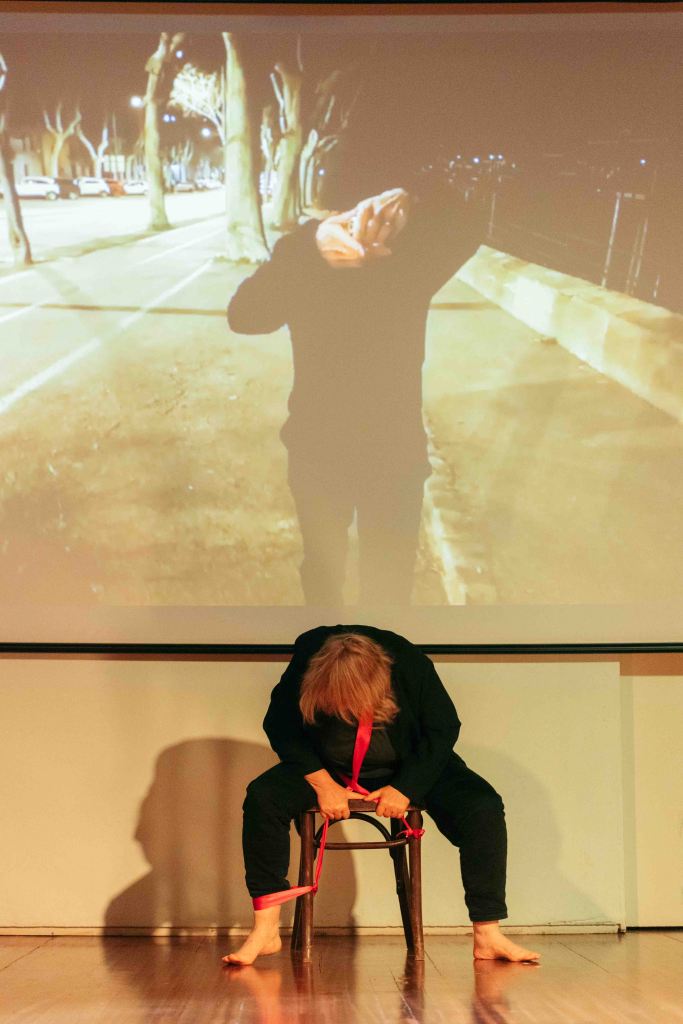
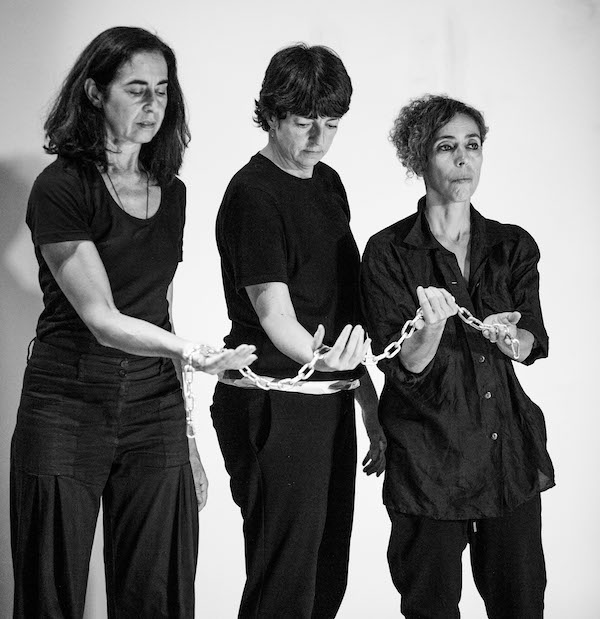
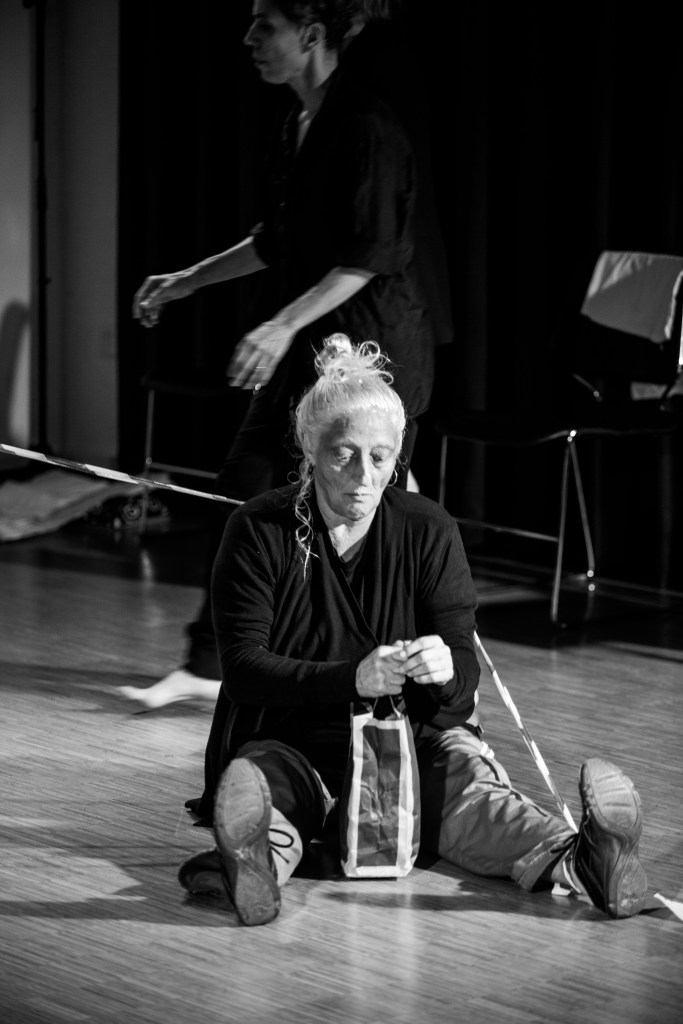
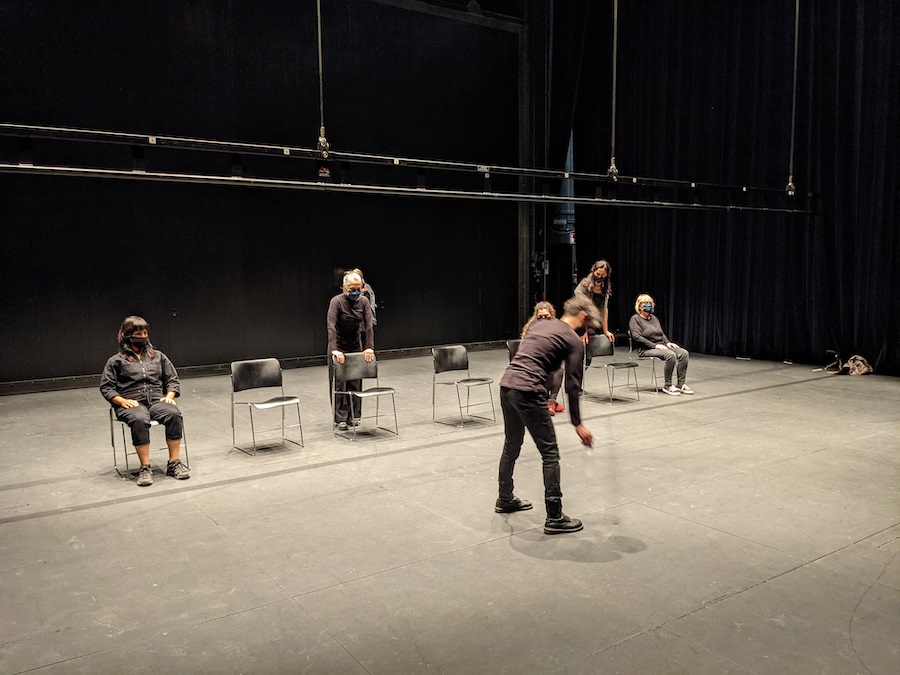
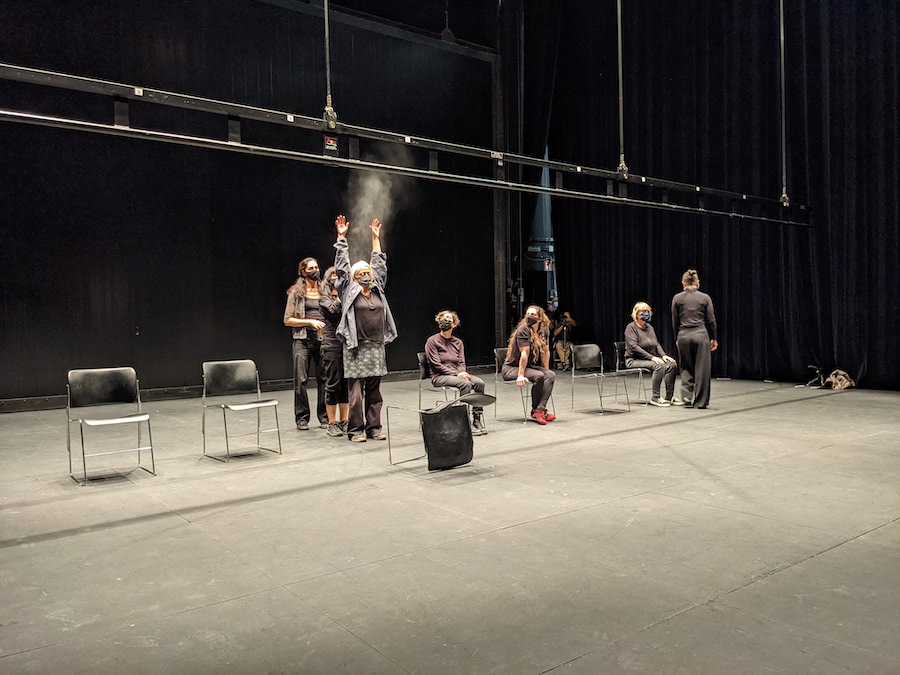
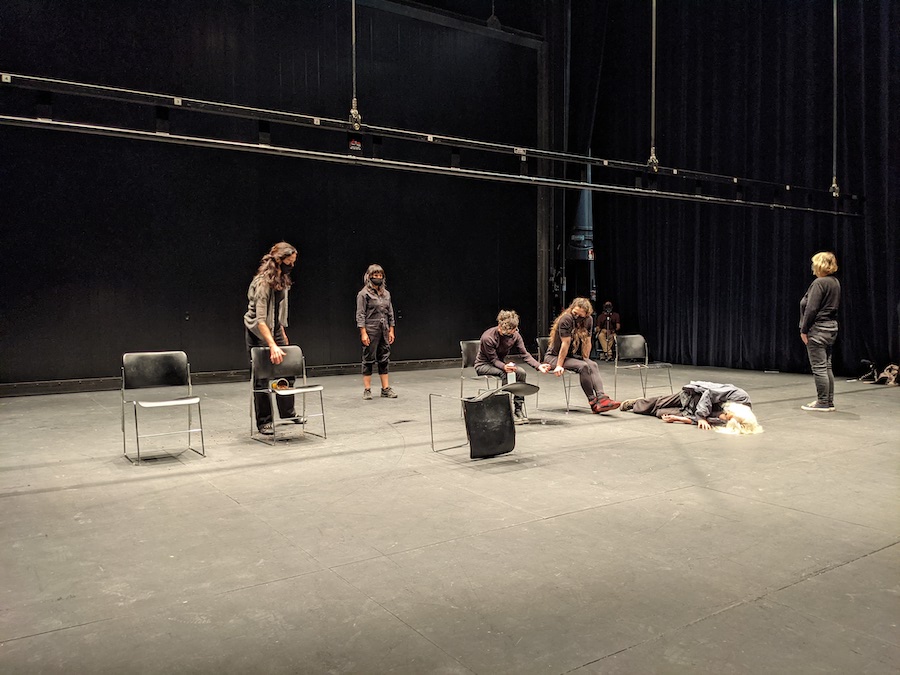
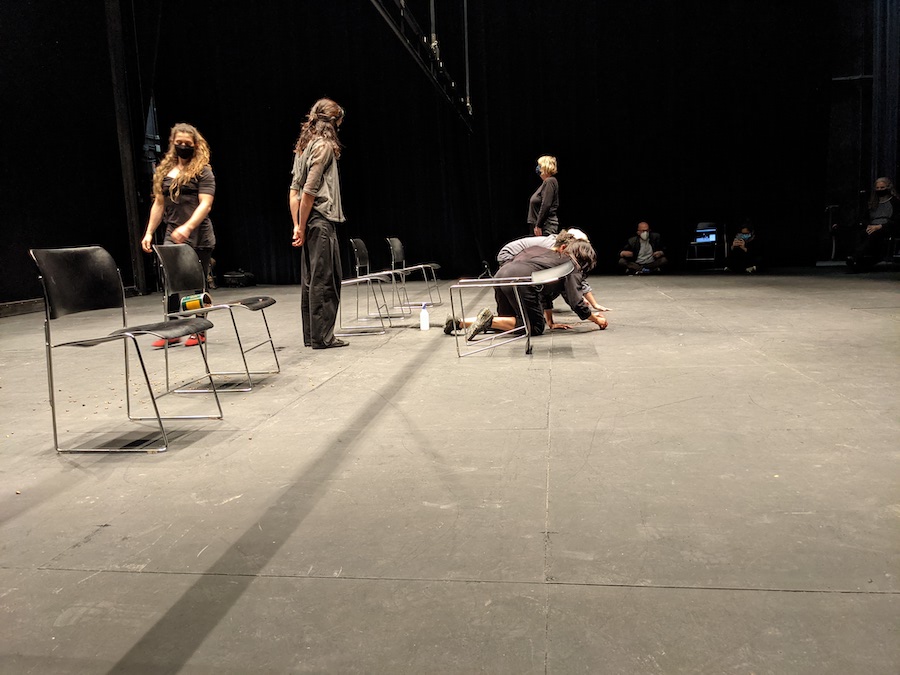
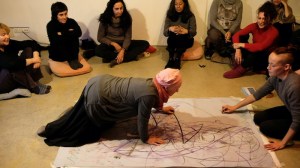
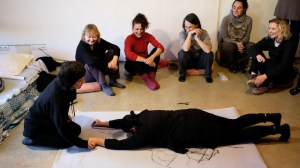
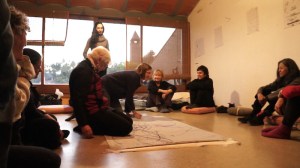
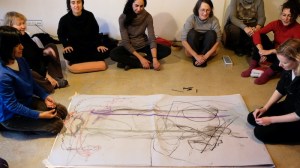
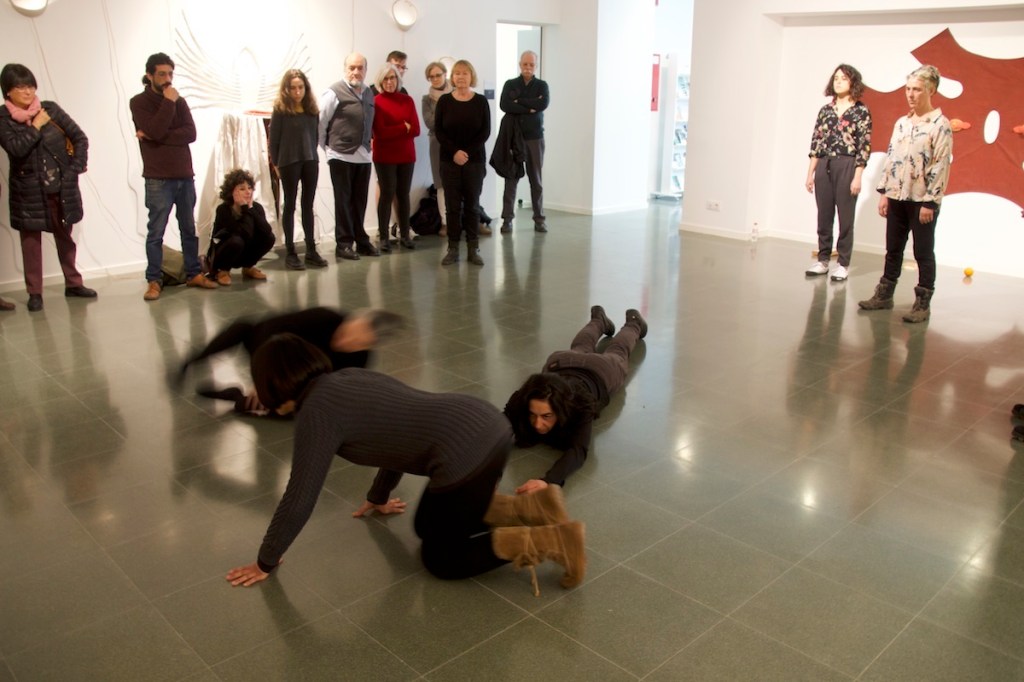
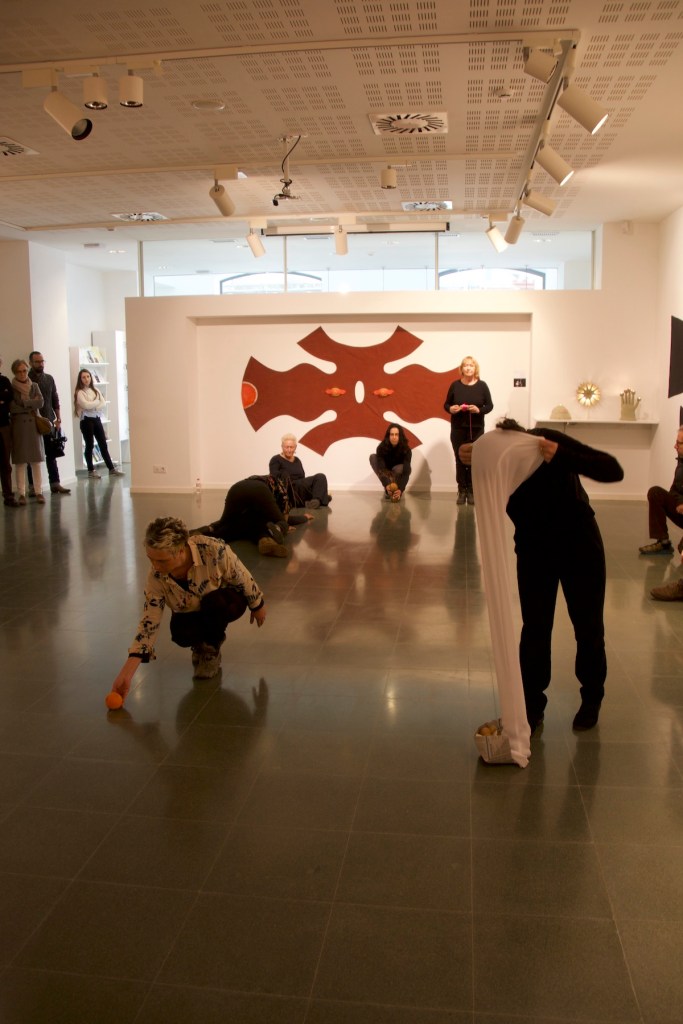
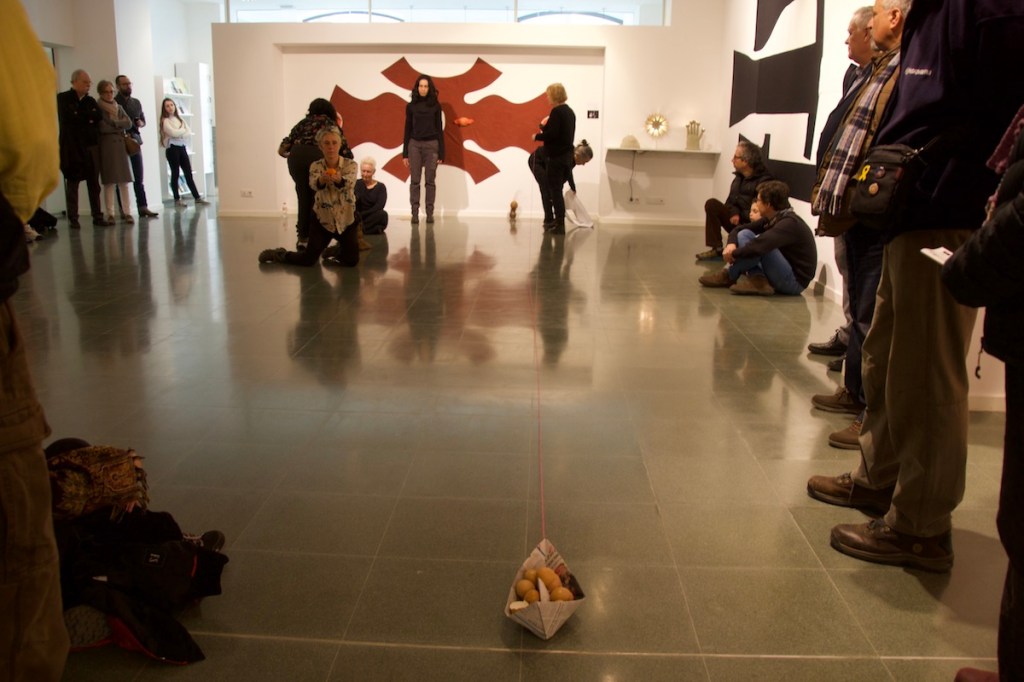
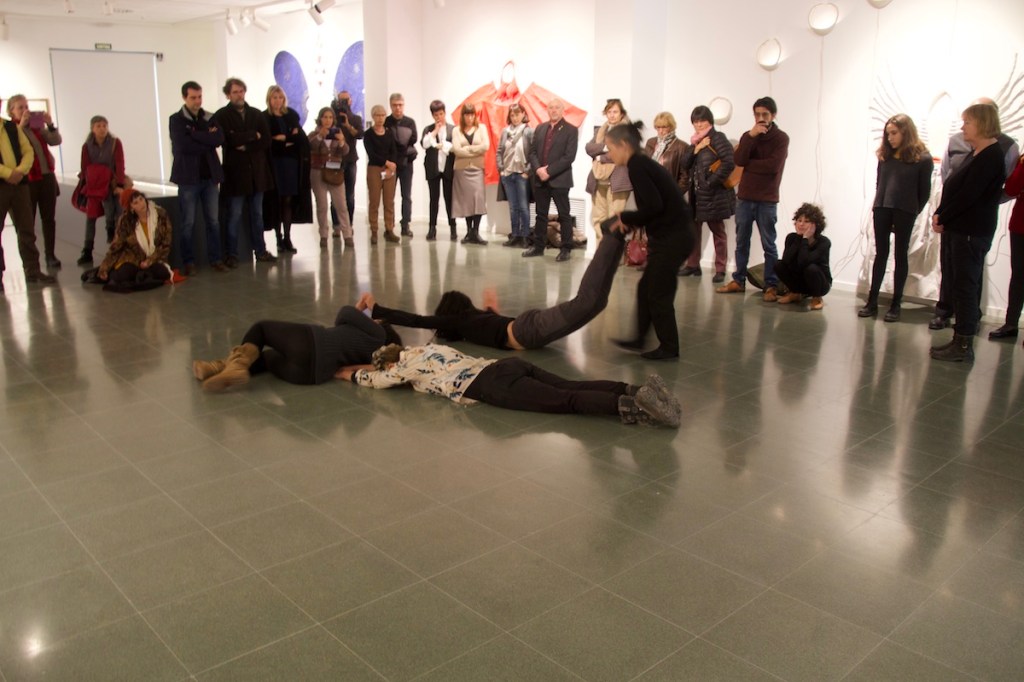
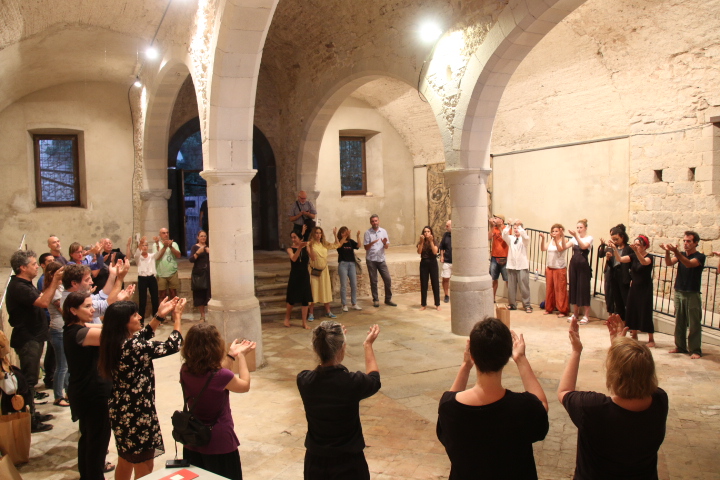
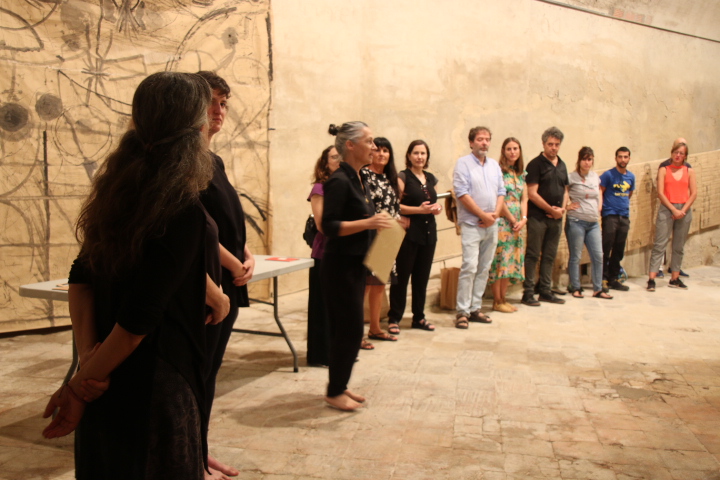
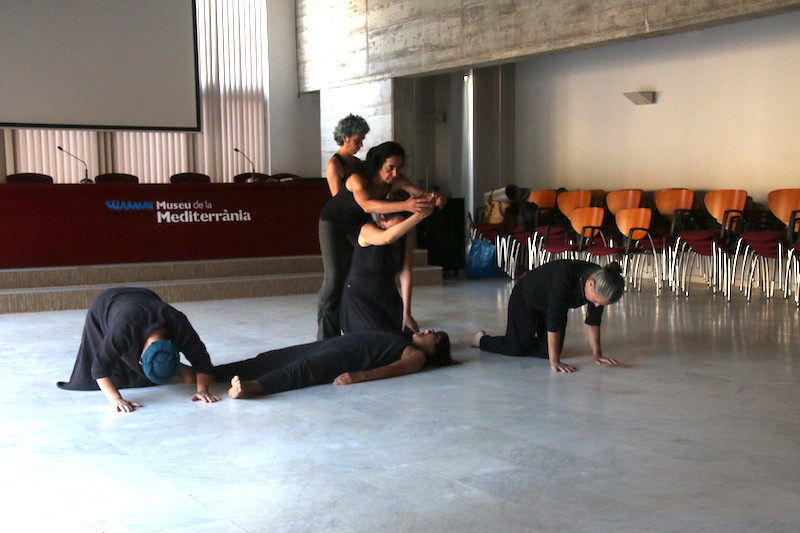
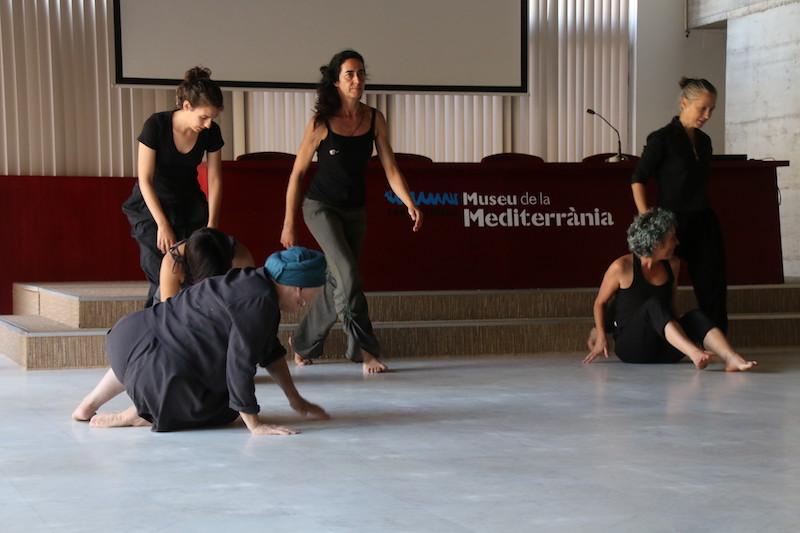
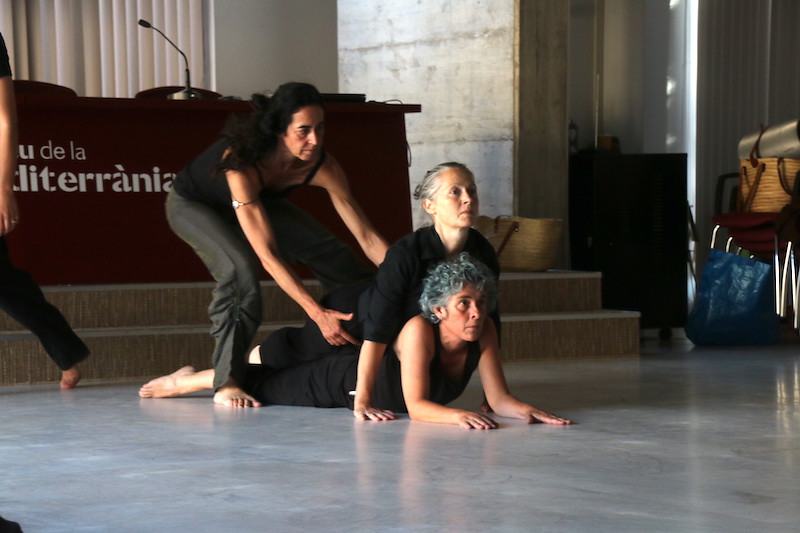
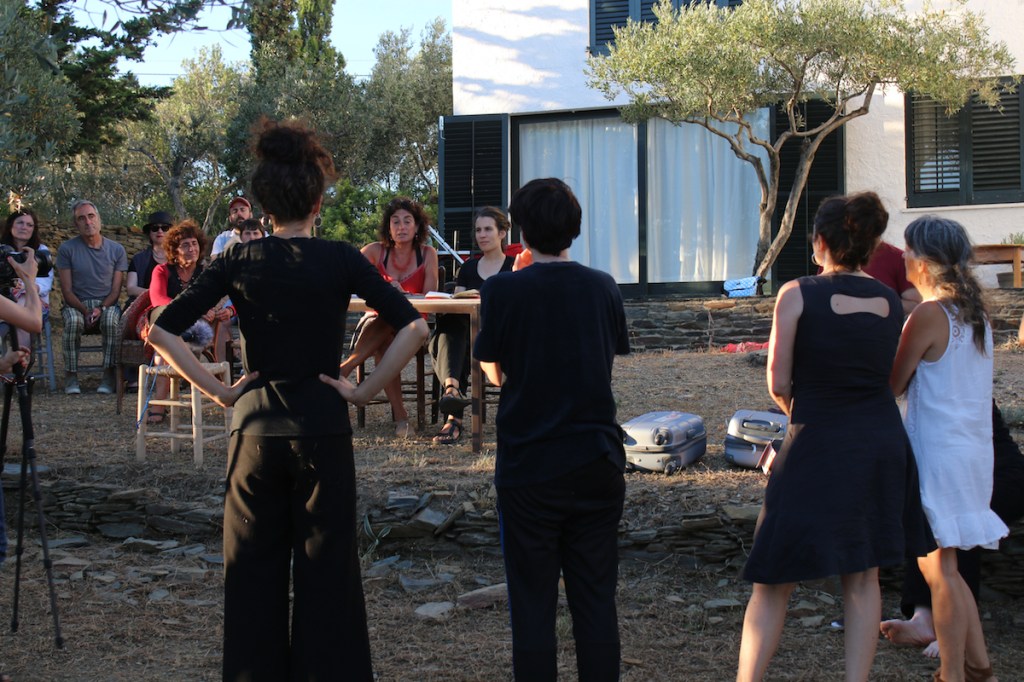
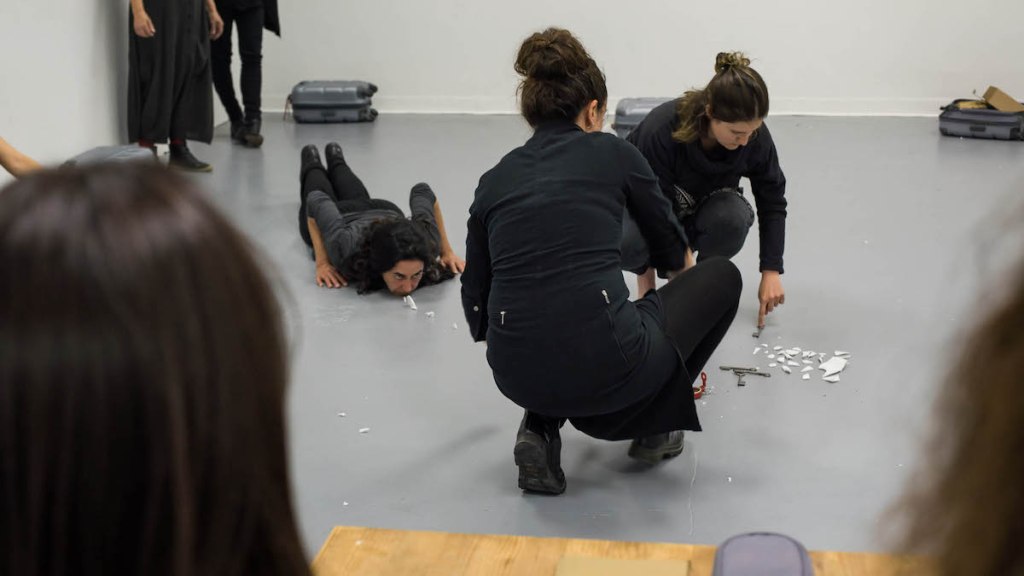
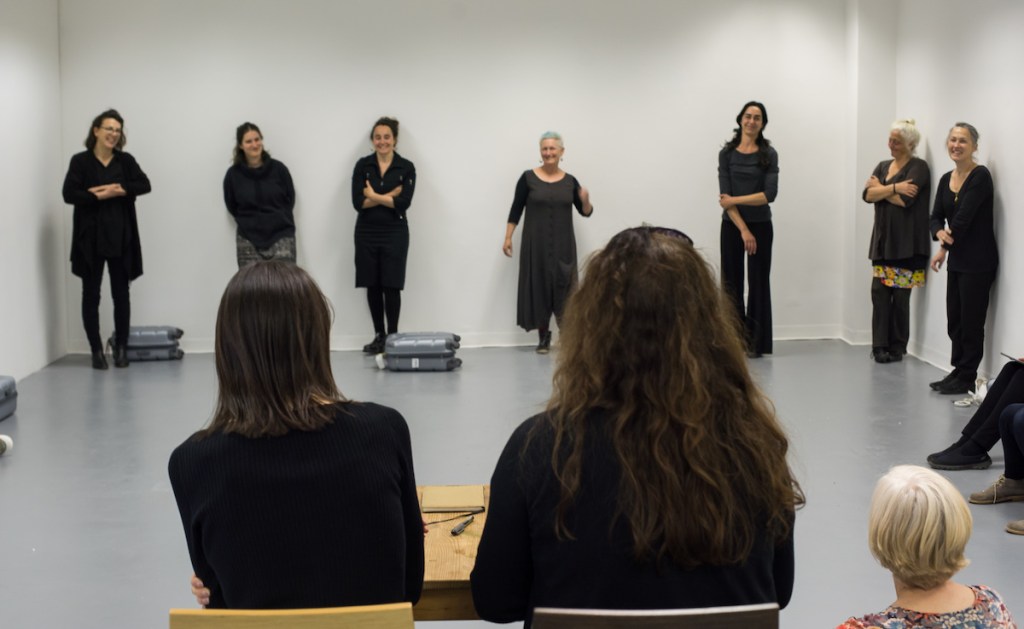
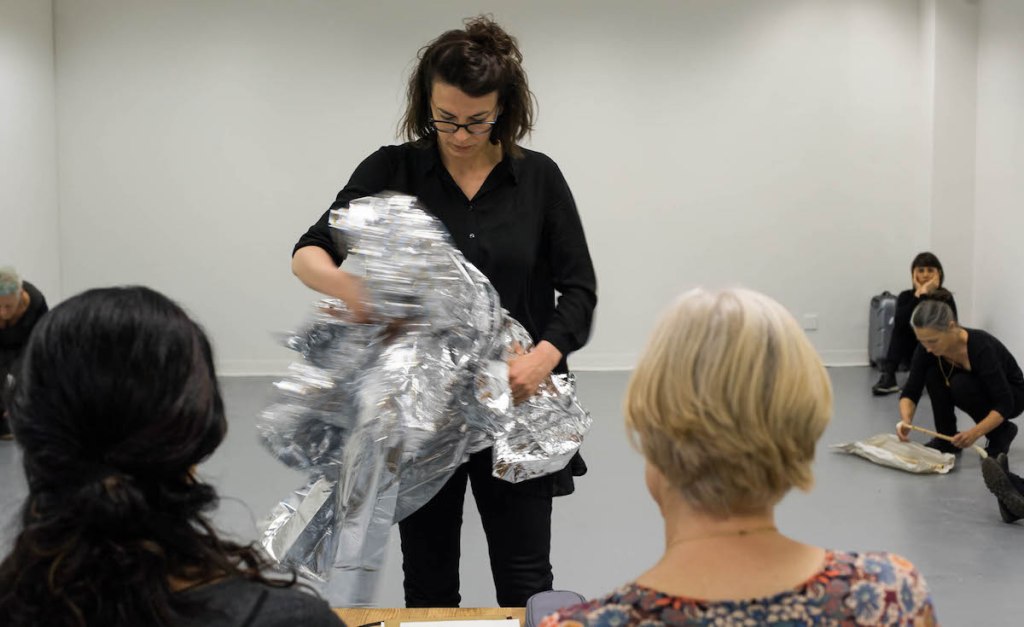
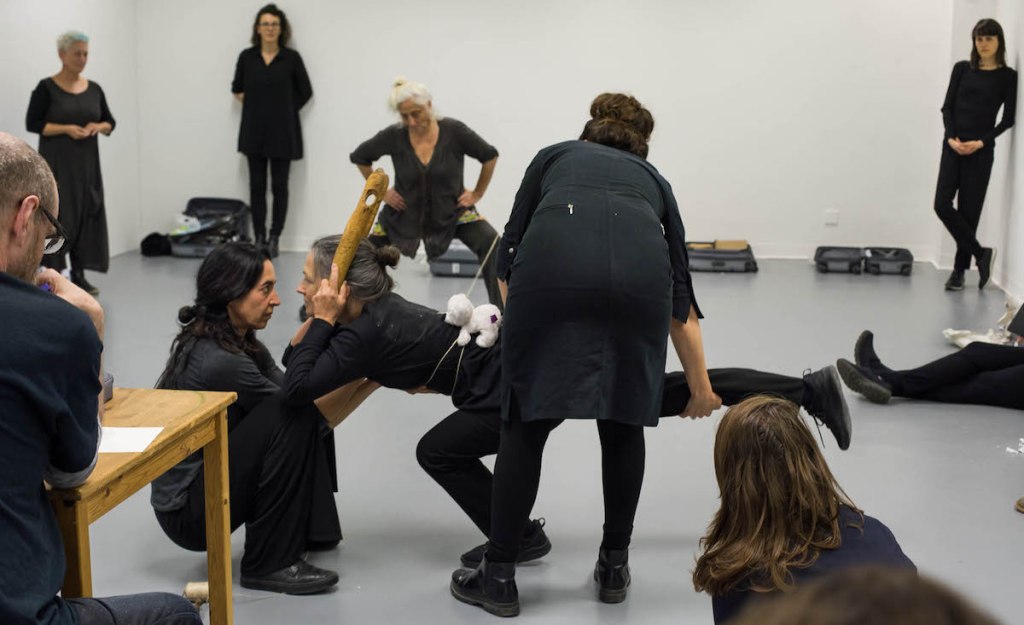
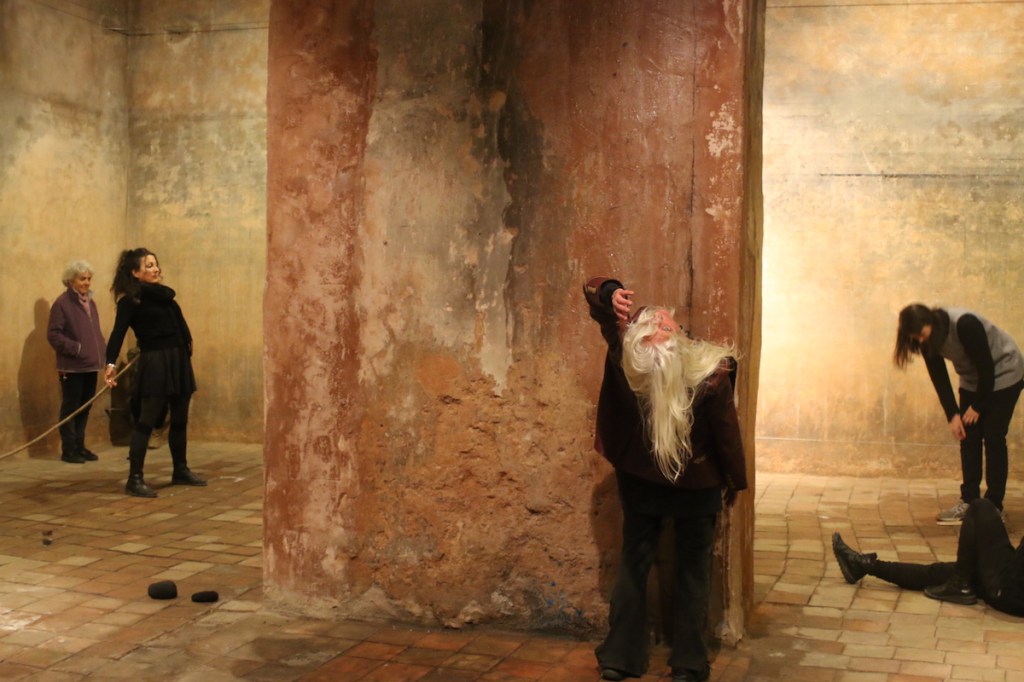
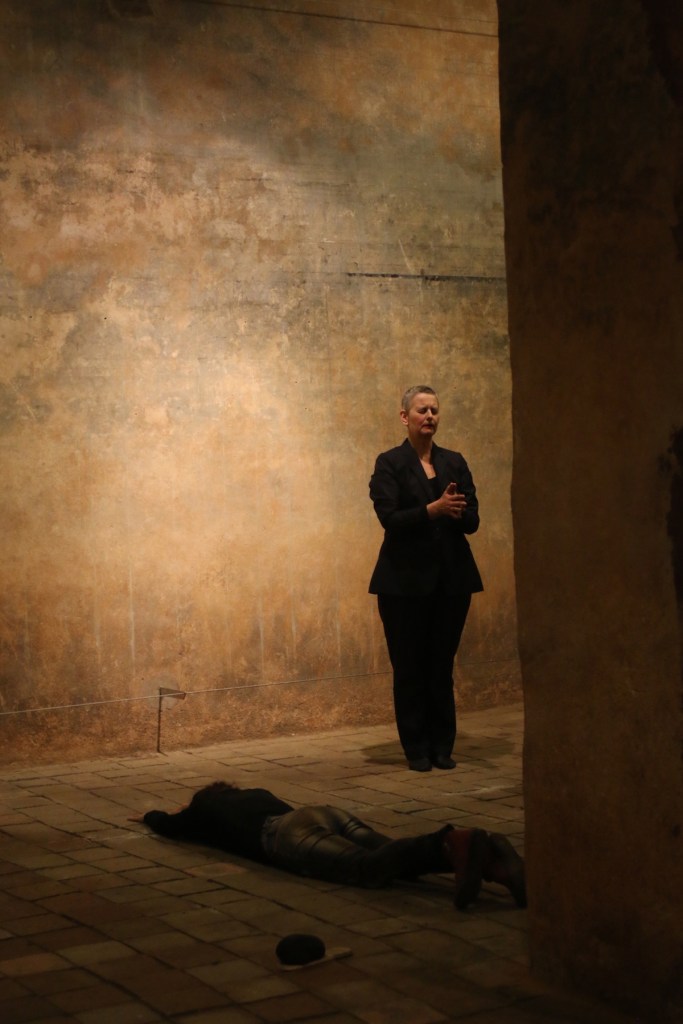
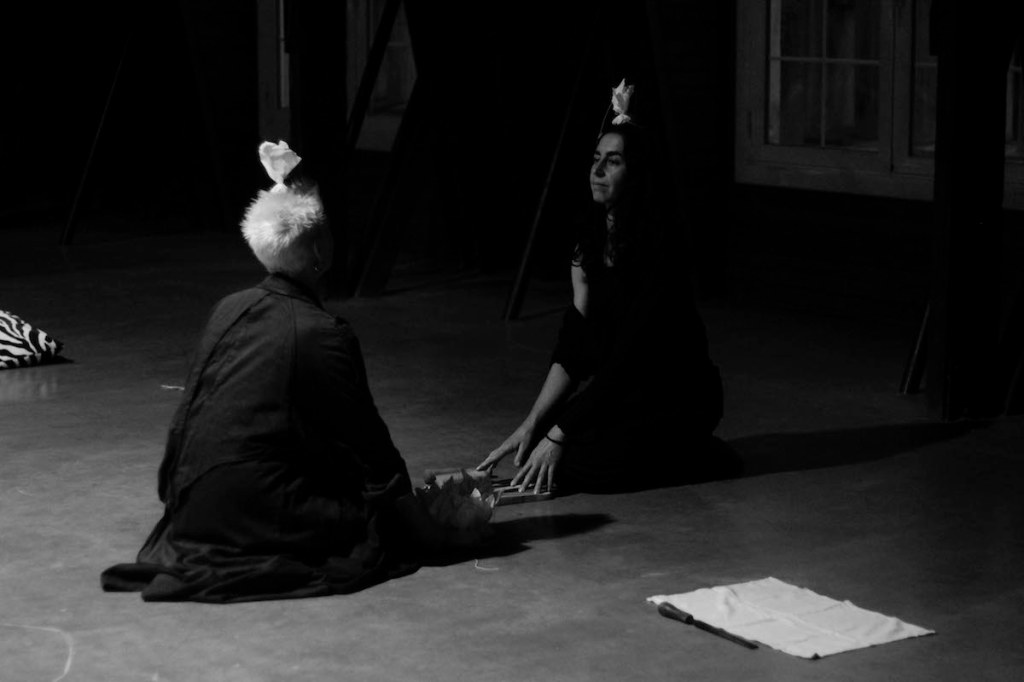
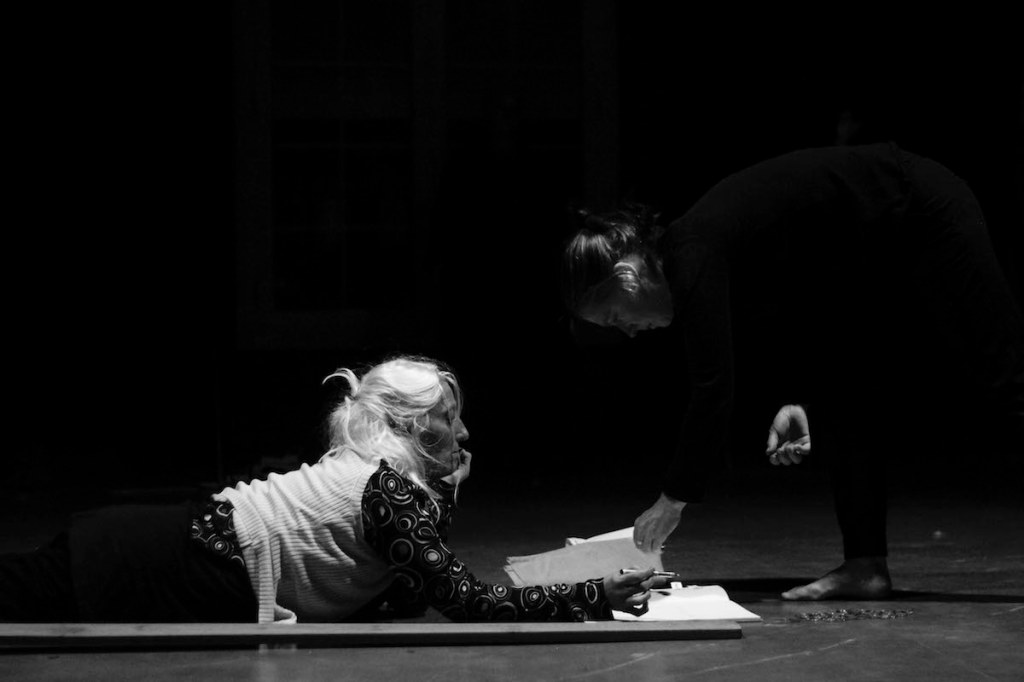
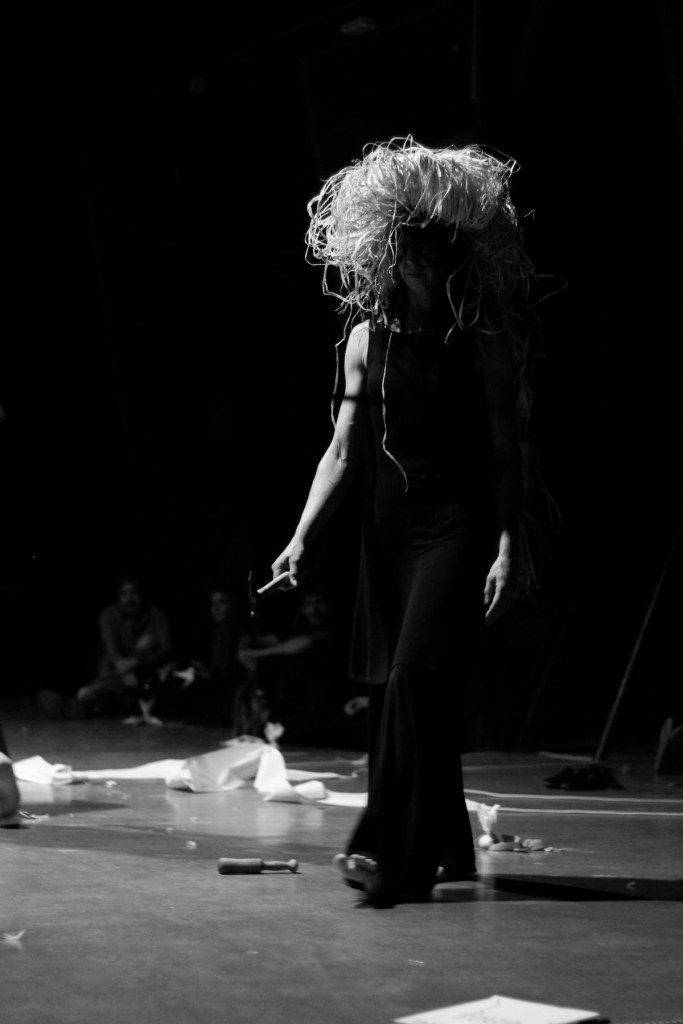
Ocells al Cap were invited in 2025 by the arts centre Santa Monica in Barcelona to continue their collaboration curating three evenings of performance in the season of events Dimecres de So I Cos (Sound and Body on Wednesdays). This performance took place on the first evening (5th March 2025).

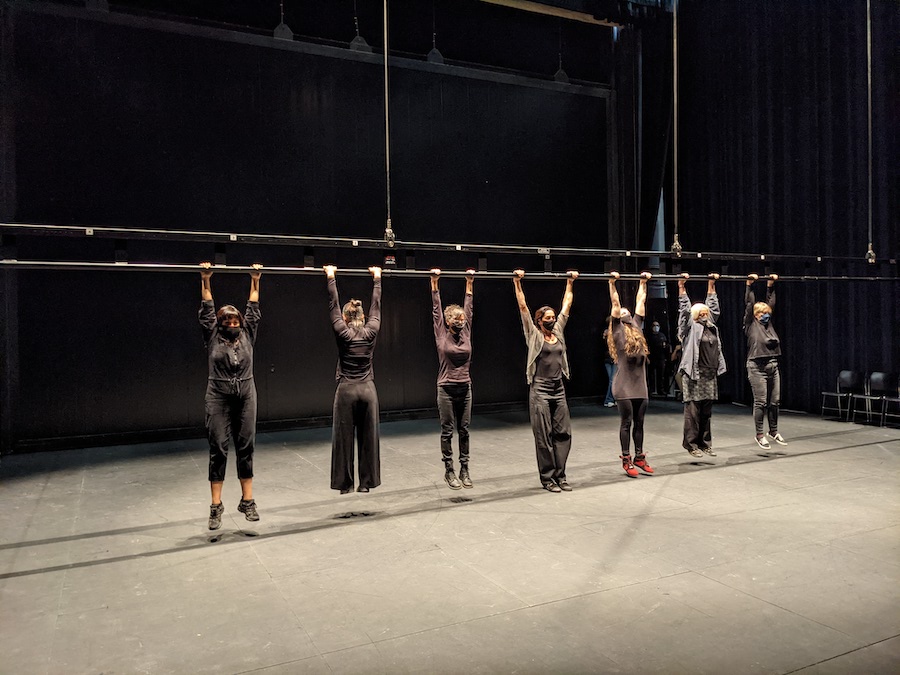
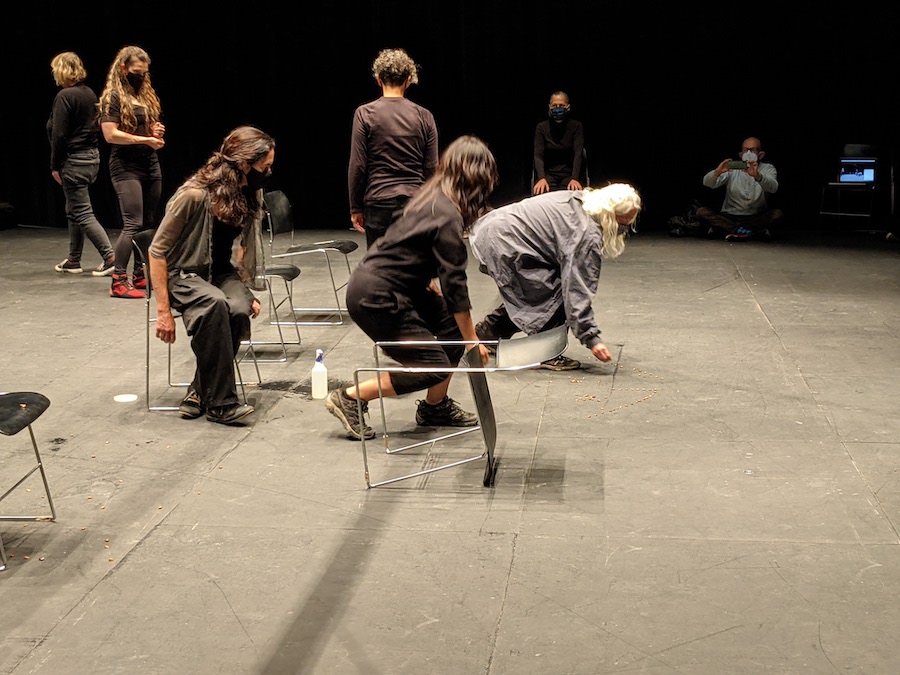
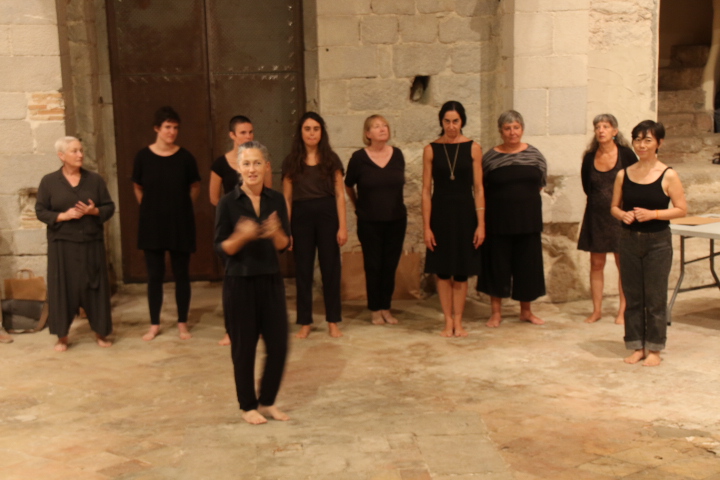
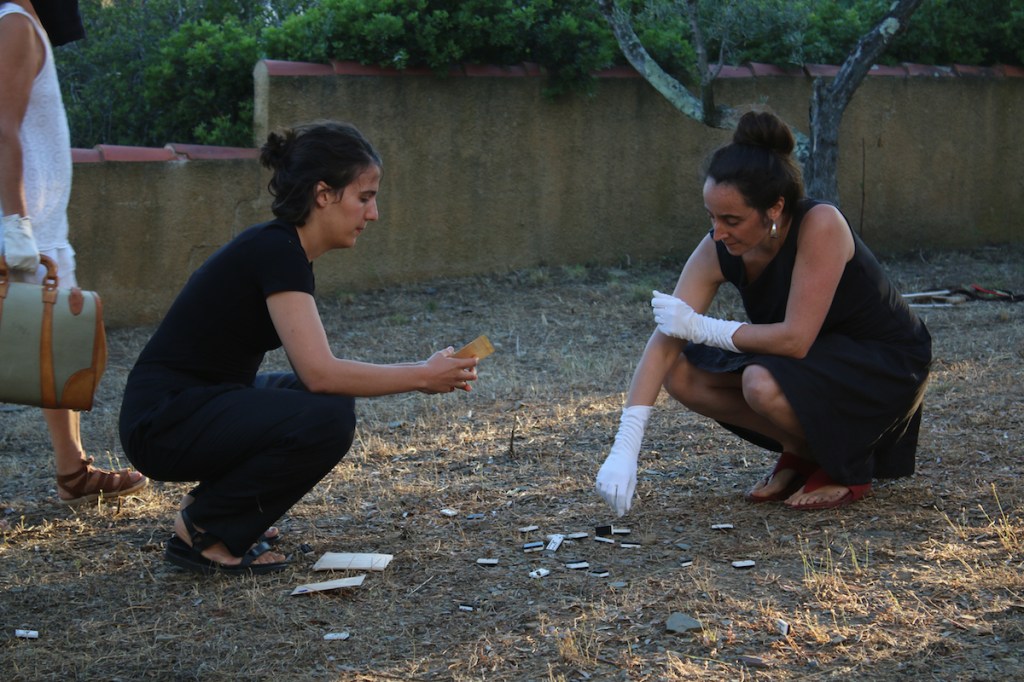
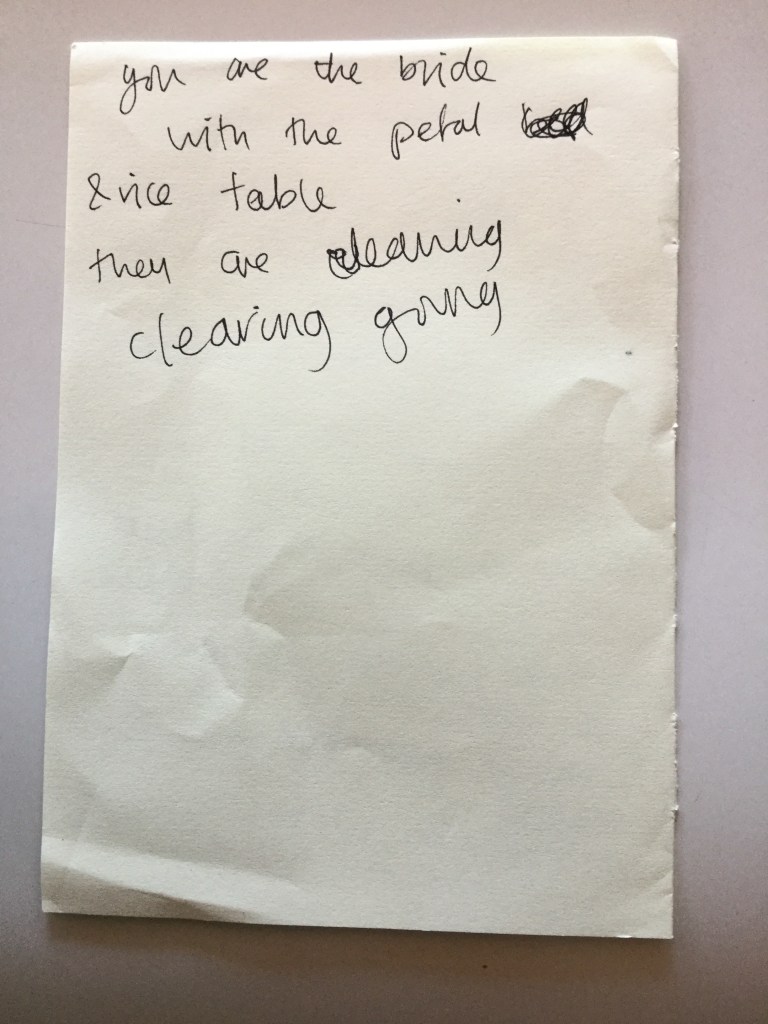
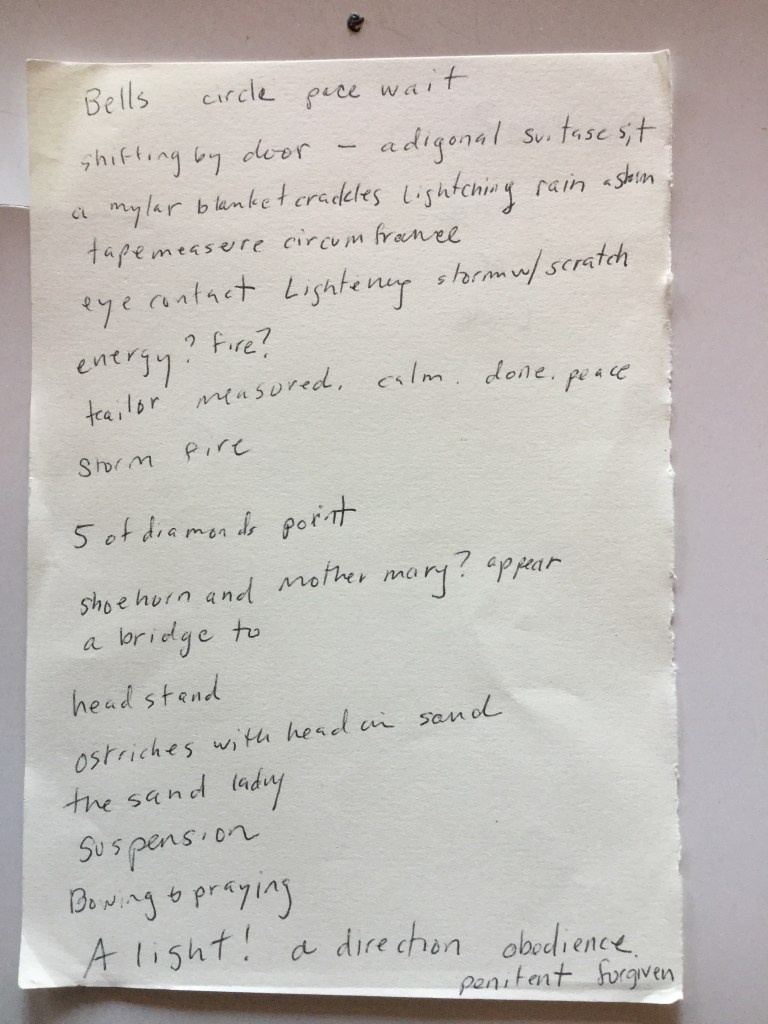
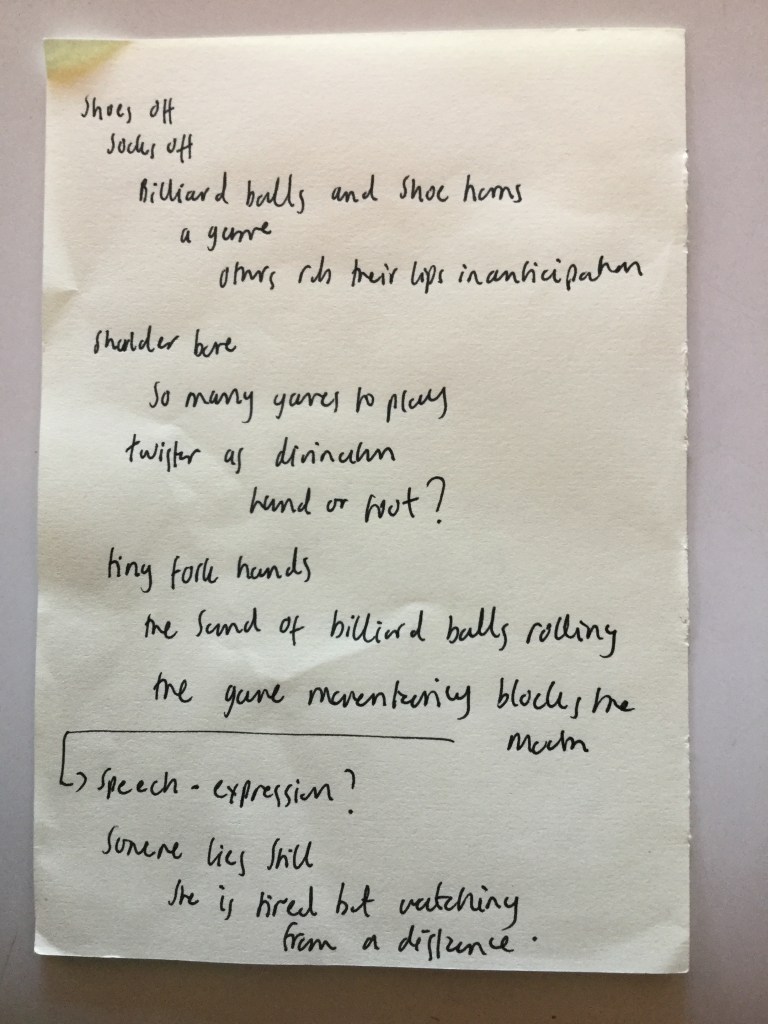
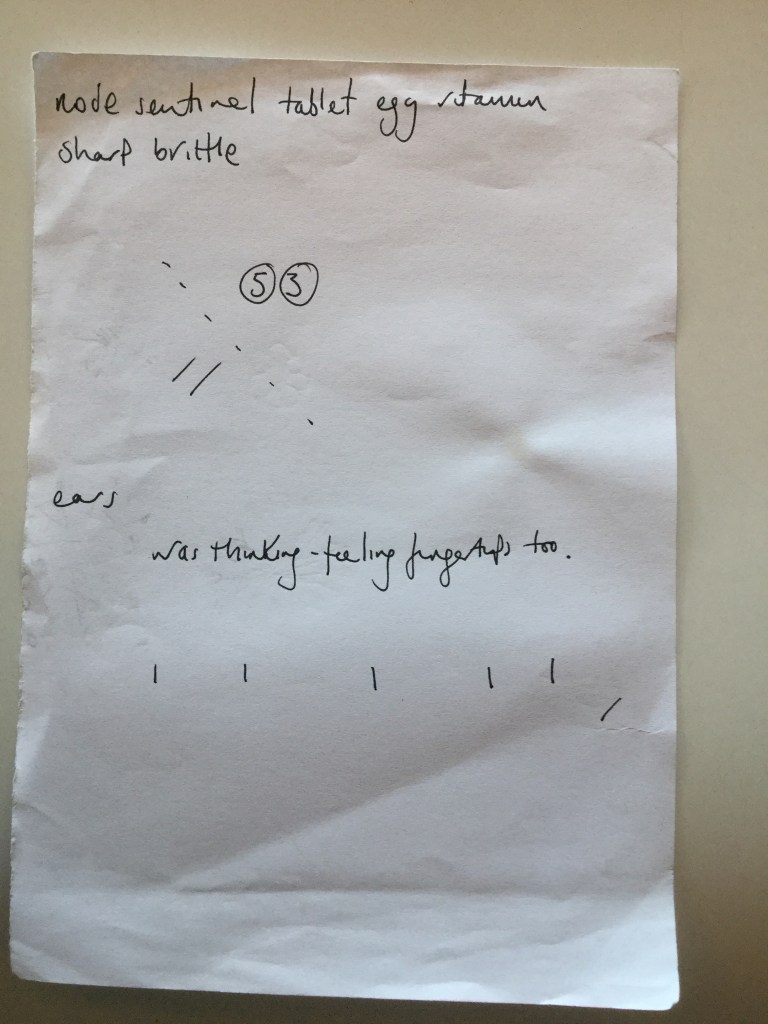
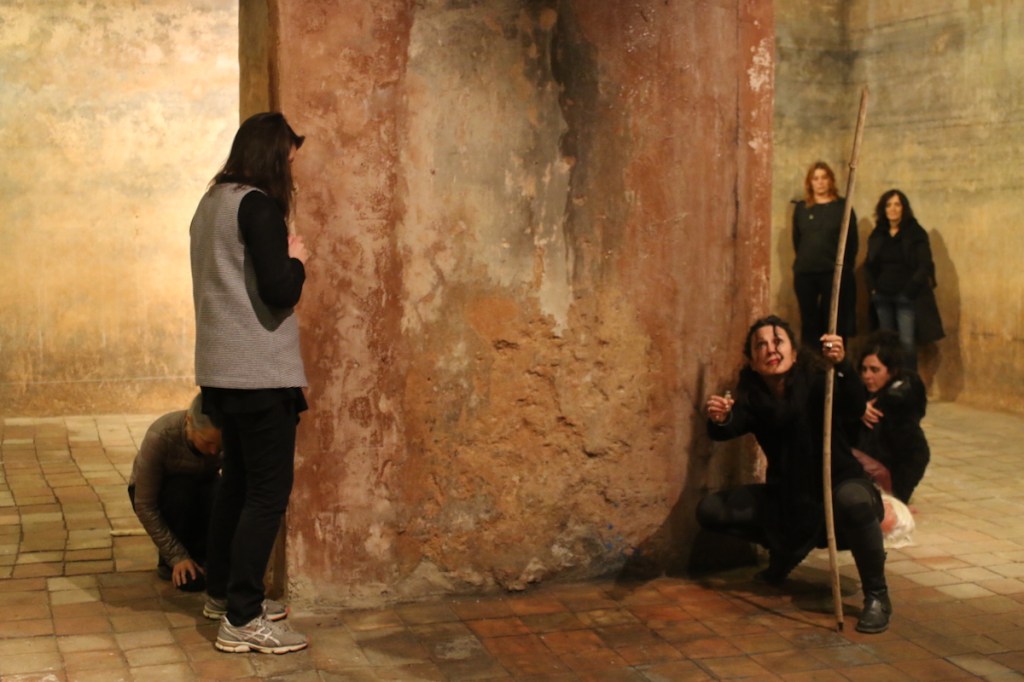
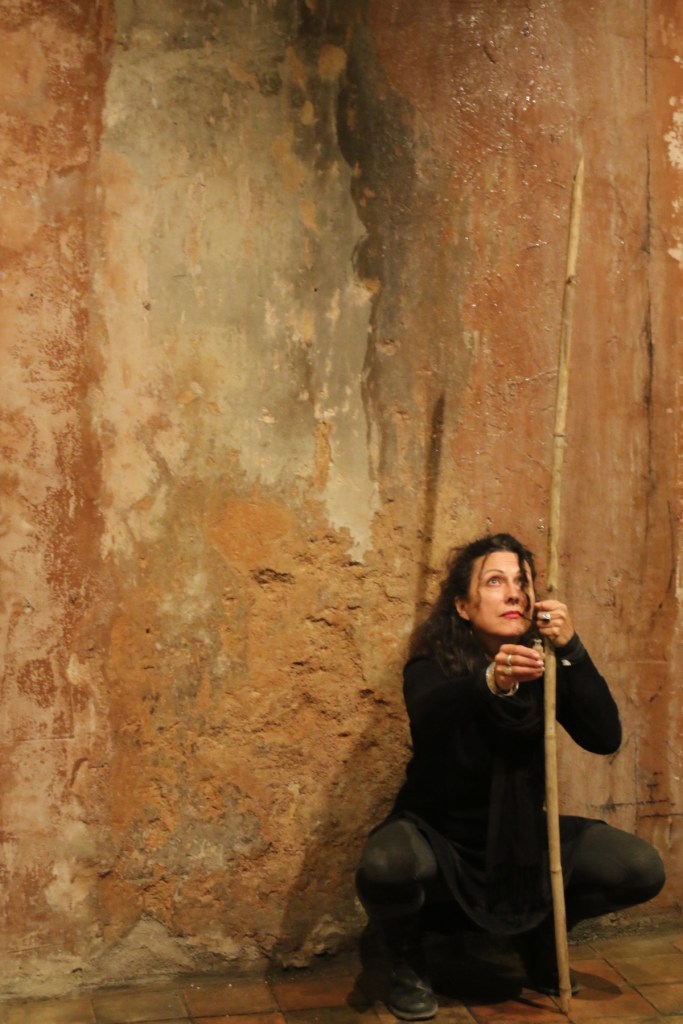
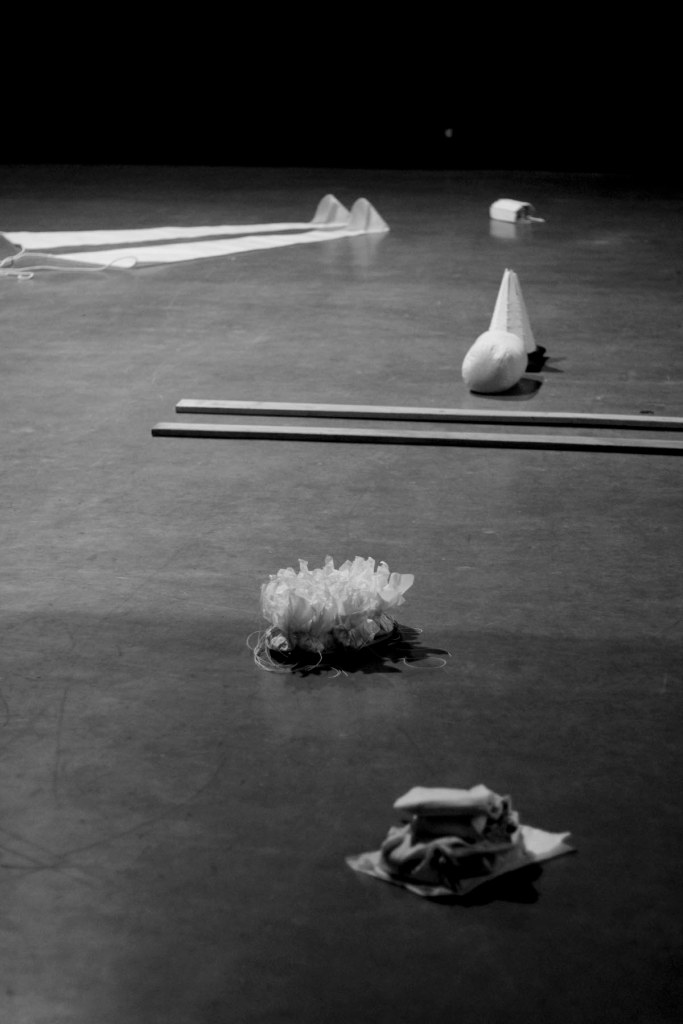
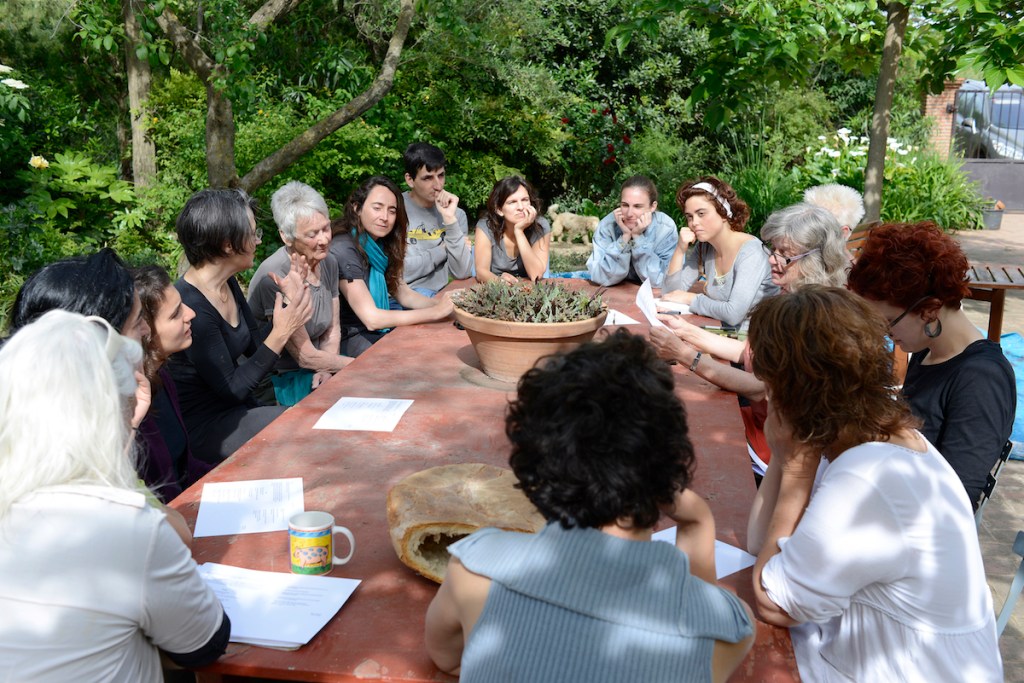
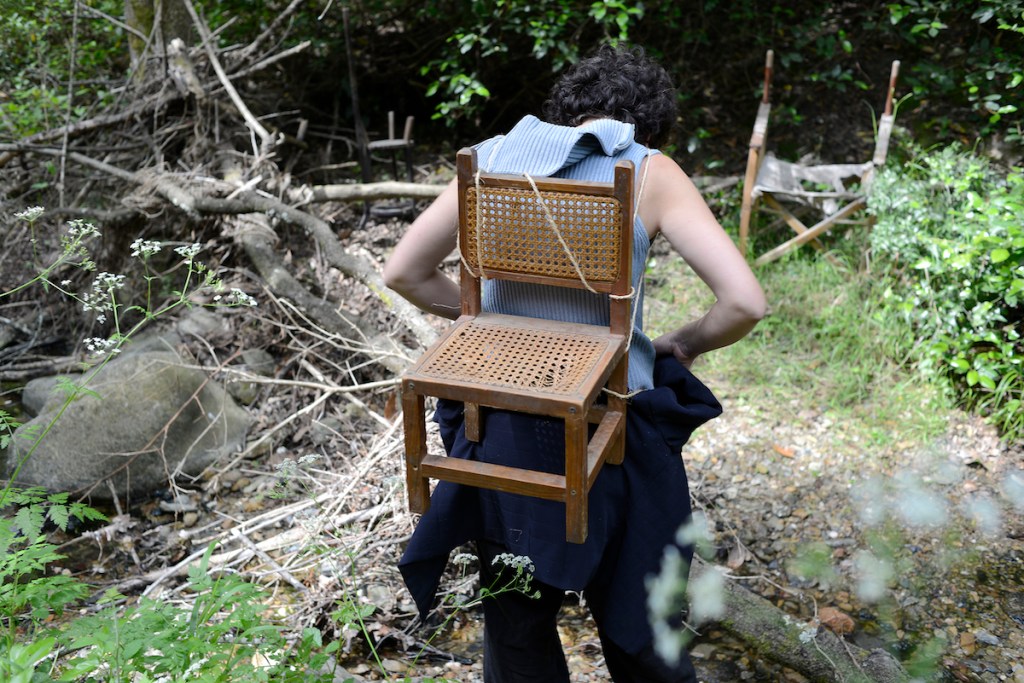
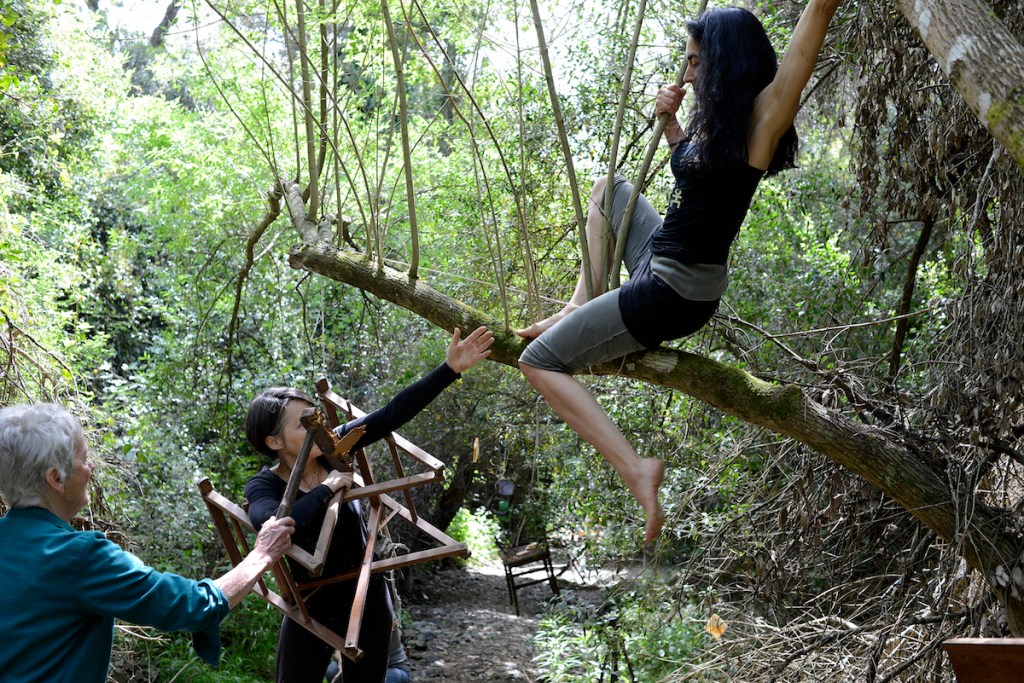
We began the evening by chanting together “the six healing sounds” to put us on the same frequency. For the preparation of the performance, each artist in the group had made their objects or props..

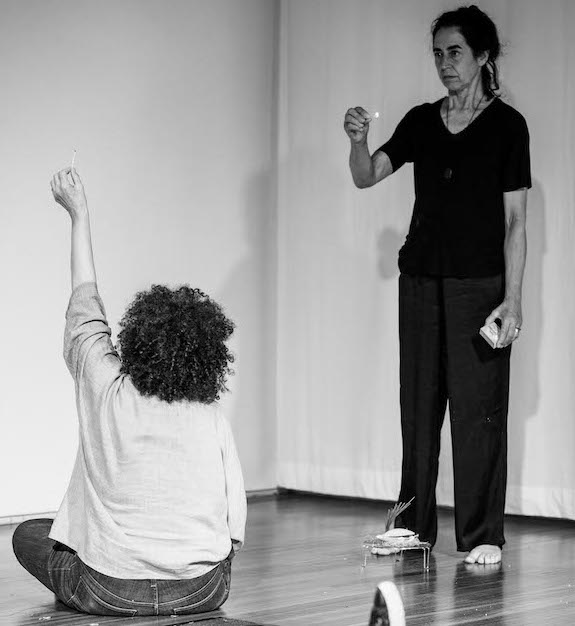
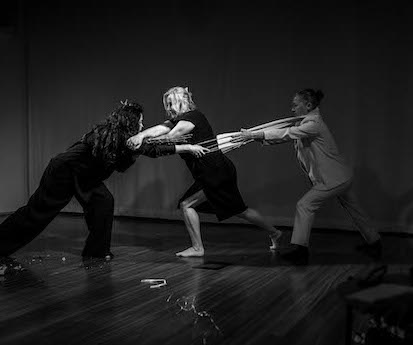
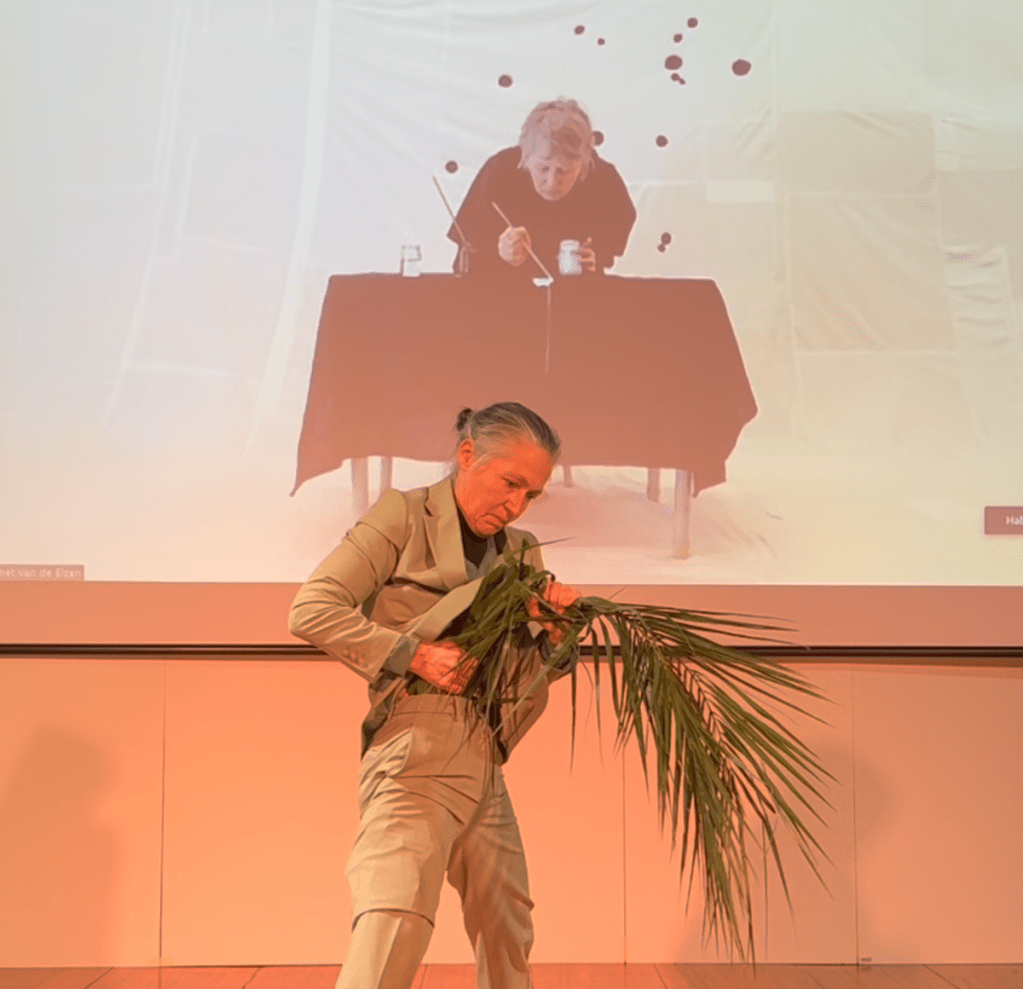
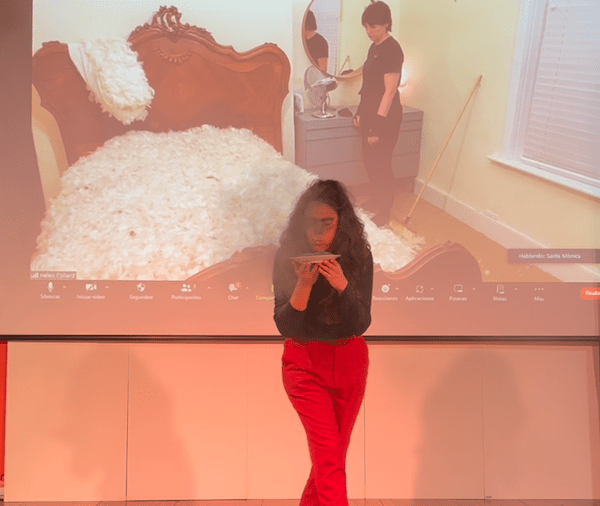
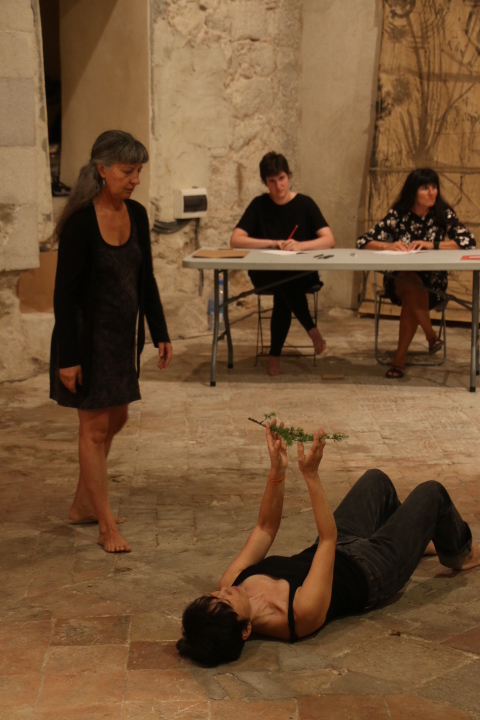
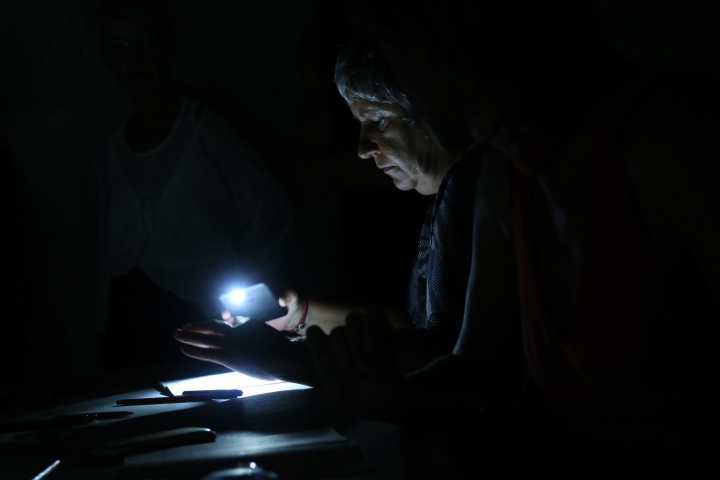
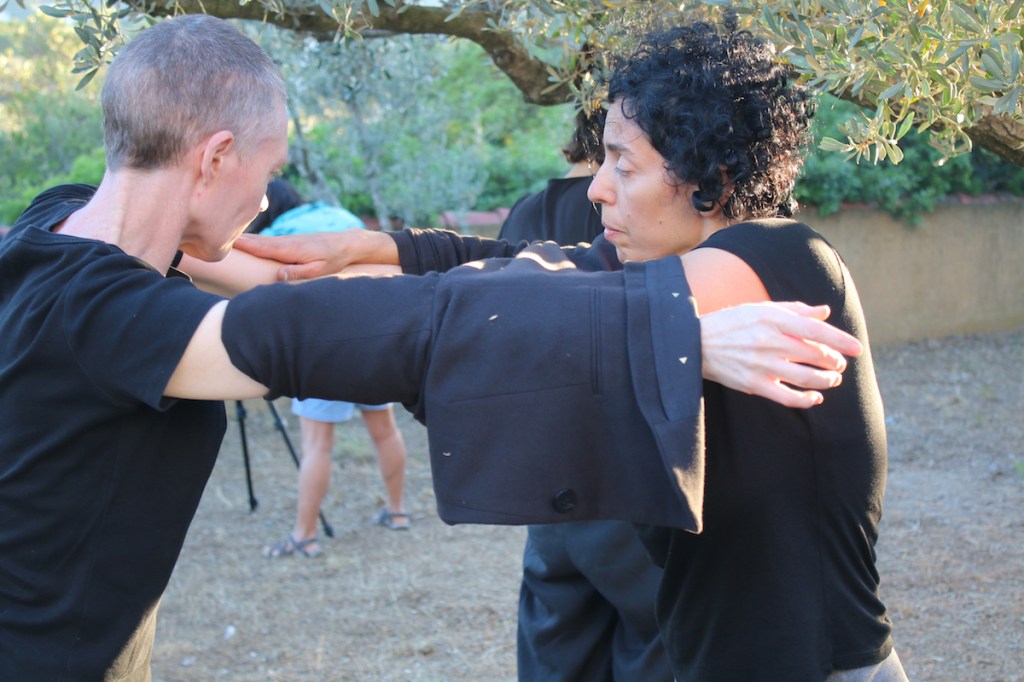
Every 10 minutes and randomly selected, two artists performed simultaneously. One of the artists was present in the gallery and the other by video conference. Synchronies appear although none of them have prior knowledge of the action of the other and afterwards the public shared their views and observations with the artists.

We prepared for this by working in a group to develop deep listening techniques with all the senses, including those that can reach beyond the body and that include the possibility of accessing the detected information of other beings or the environment. This was an investigation about synchronicity and telepathy.

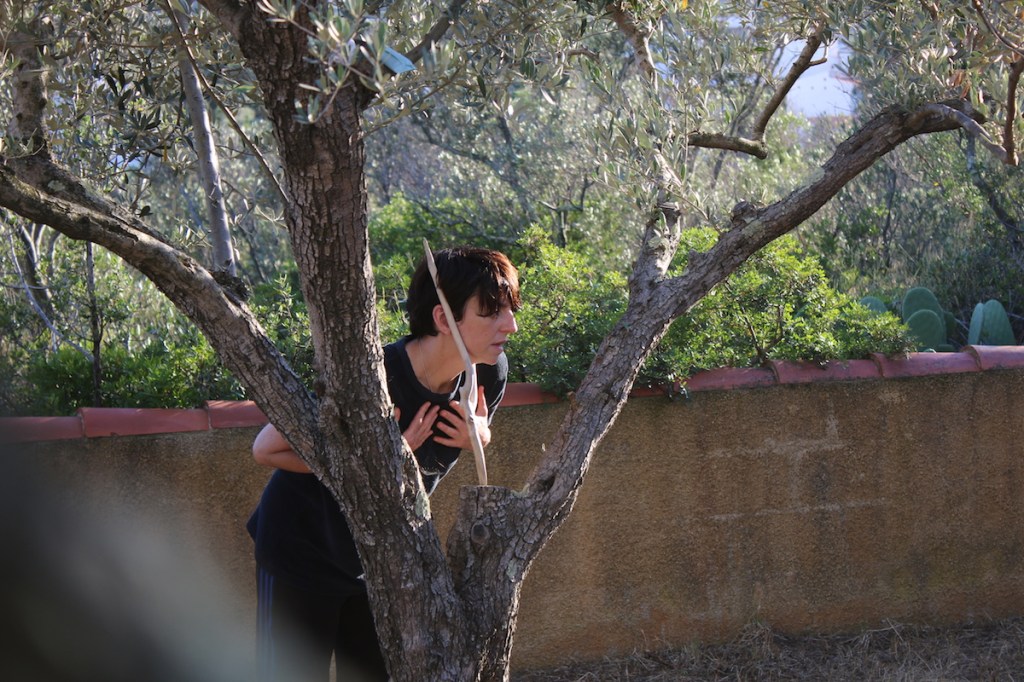
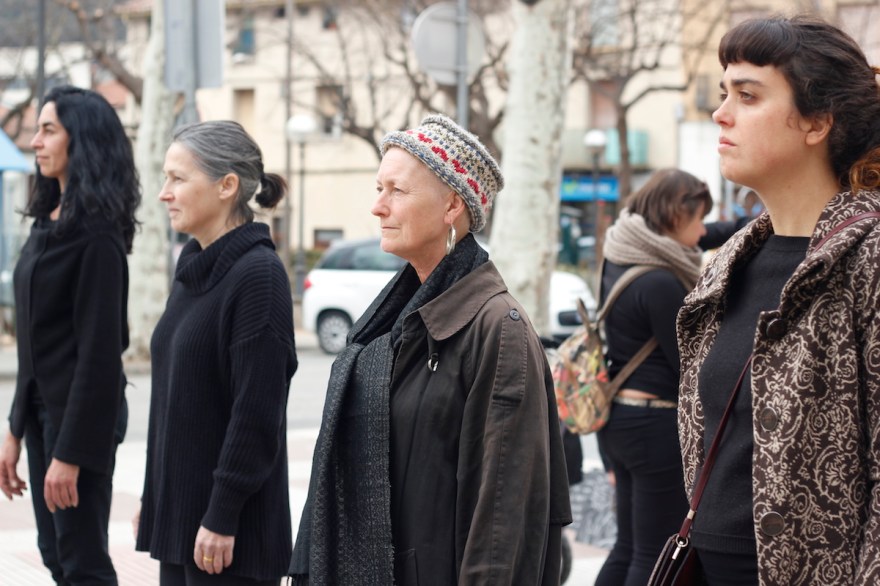
The artists who participated in person were: Juliette Murphy, Mariona Vilaseca, Helen Collard, Denys Blacker, Toni Crabb, Mireia Zantop and Bernadette Hopkins,
The artists connected by online video were: Anita Ponton, Hilla Steingard, Siobhan Mullen, Bernadette Hopkins, Holly Slingsby, Danièle J Minns, Martine Viale and Deej Fabyc.

The photos were taken by Marta Vilardell

We Were Waiting for You – 2024

Ocells al Cap were invited in 2024 by the arts centre Santa Monica in Barcelona to curate three evenings of performance in the season of events Dimecres de So I Cos (Sound and Body on Wednesdays). This performance took place on the third evening (23rd October 2024). This meeting was dedicated to Lesley Yendell, our great friend and colleague on the 4th anniversary of her death in 2020. Her husband Lucho Hermosilla also took part by offering a performance at the start of the evening.

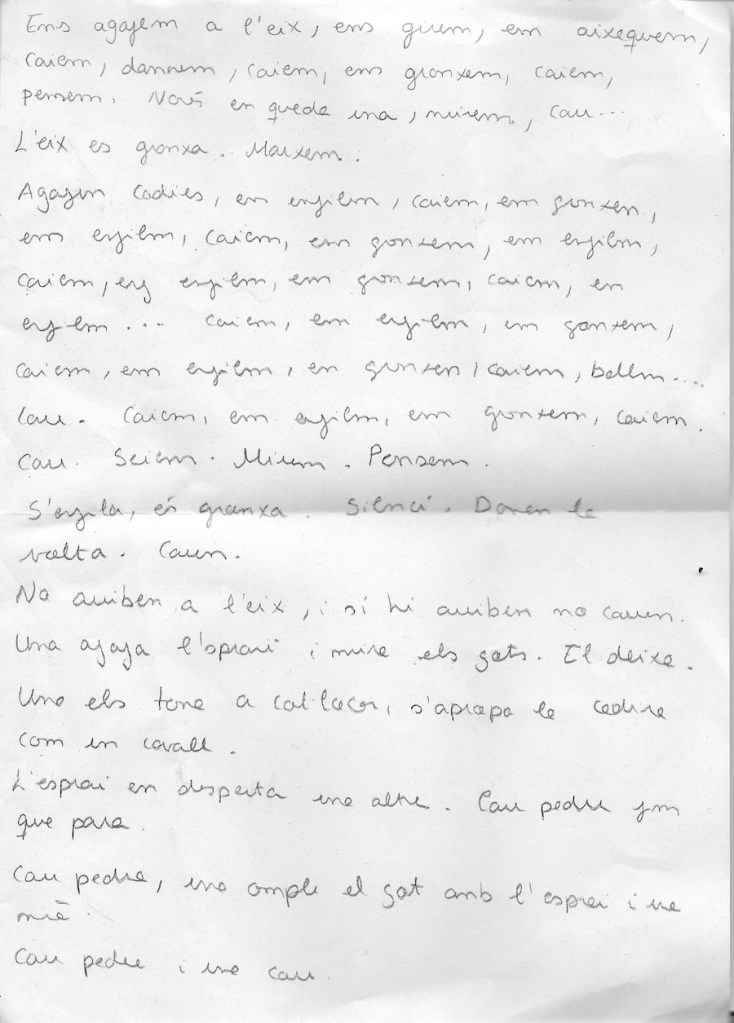
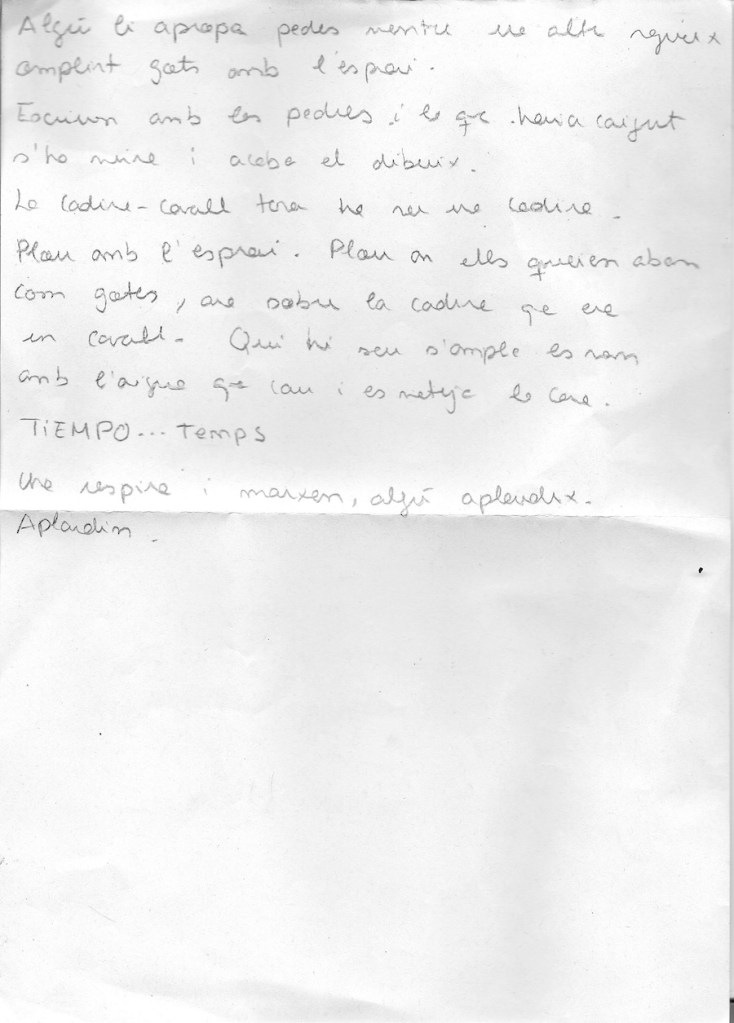
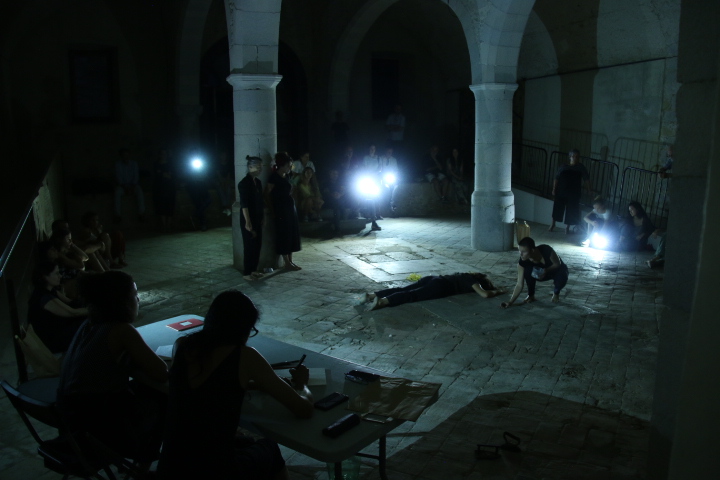
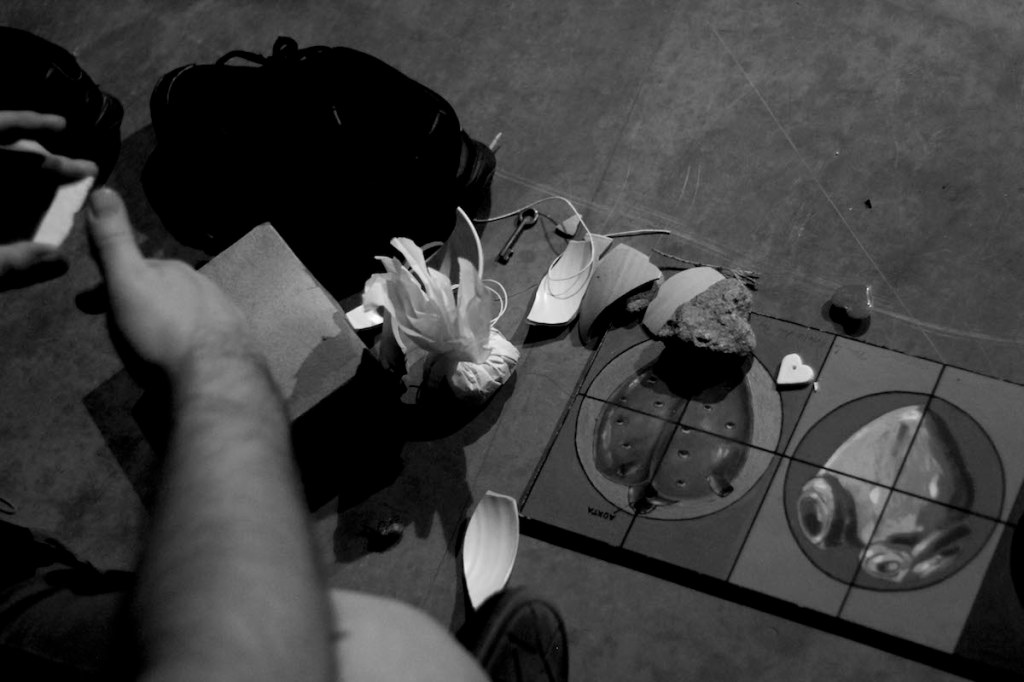
We began the performance by inviting the audience to participate in a breathing exercise. We chanted together “the six healing sounds” and the vibrations felt in the body put us in the same frequency. For the preparation of the performance, each artist in the group had previously selected six objects that they brought to the performance in a bag. We asked the audience if anyone would like to write down a question they might have at this moment in their lives. The question could be personal, universal or very specific. The volunteer Consultant then wrote their question on a piece of paper and hid it from view. It was not seen by artists or the public. The Consultant was asked to send the question by telepathy to the artists. The artists responded by improvising with their objects and with the other artists. The Consultant sat at a table with a paper and pen and an artist at by their side (the Scribe). They both write down on the paper everything they see, without thinking too much, just responding to what is happening in the performance as it unfolds. It is a style of writing that due to its immediacy, seems more like automatic writing or stream of consciousness. At the end of each improvisation the texts were read out loud and finally the Consultant shared their question. We looked for meaningful interconnections between what had happened in the performance, what was written down by the Consultant and the Scribe and the content of the question. The public shared their views and observations with the artists.

The artists who participated were: Anna Subirana, Juliette Murphy, Martine Viale, Helen Collard, Denys Blacker, Toni Crabb, Natàlia Espinet, Mireia Zantop and Bernadette Hopkins,

The photos were taken by Claudia Serrahima

We Were Waiting for You – 2024

Ocells al Cap took part in the International Contemporary Art Festival MAMA in Madremanya, Girona

Ocells al Cap presented a version of We Were Waiting for You at MAMA Festival on the 30th August 2024. For the preparation of the performance, each artist in the group had previously selected objects that they brought to the performance in a bag. We asked the audience if anyone would like to write down a question they might have at this moment in their lives. The question could be personal, universal or very specific. The volunteer Consultant then wrote their question on a piece of paper and hid it from view. It was not seen by artists or the public. The Consultant was asked to send the question by telepathy to the artists. The artists responded by improvising with their objects and with the other artists. The Consultant sat at a table with a paper and pen and an artist at by their side (the Scribe). They both write down on the paper everything they see, without thinking too much, just responding to what is happening in the performance as it unfolds. It is a style of writing that due to its immediacy, seems more like automatic writing or stream of consciousness. At the end of each improvisation the texts were read out loud and finally the Consultant shared their question. We looked for meaningful interconnections between what had happened in the performance, what was written down by the Consultant and the Scribe and the content of the question. The public shared their views and observations with the artists.

The artists who participated were Marta Vergonyós, Anna Subirana, Juliette Murphy, Martine Viale, Montse Seró, Helen Collard, Denys Blacker, Natàlia Espinet, Mireia Zantop and our guest participant, Ramon Guimaraes.

The photos were taken by Claudia Serrahima

Les Antecessores – 2024

Ocells al Cap were invited in 2024 by the arts centre Santa Monica in Barcelona to curate three evenings of performance in the season of events Dimecres de So I Cos (Sound and Body on Wednesdays). On the second evening (the 22nd May 2024) Each artist chose an image of a historical work of art that moved them in some way (painting, sculpture, performance, poetry, photography, etc.), and a short text describing why this image was meaningful to them. They also brought an object. Both the image and the text were sealed in an envelope. None of the participating artists had previous knowledge of what the others would do, nor of their choice of image and object.

The artists who performed were: Denys Blacker, Toni Crabb, Nieves Correa, Natàlia Espinet, Paloma Orts, Melina Peña, Mireia Zantop and Bernadette Hopkins,
During the event, we observed the work for synchronicities and connecting threads of meaning. There was a fruitful and inspiring discussion afterwards between the artists and the audience.

The photos were taken by Claudia Serrahima


Telepathic Duets 2024

Ocells al Cap were invited by the arts centre Santa Monica in Barcelona to curate three evenings of performance in the season of events Dimecres de So I Cos (Sound and Body on Wednesdays). On the first evening (the 24th January 2024), there were two groups of artists. One group were physically present in the arts centre Santa Monica, and the other group were connected to the arts centre by video from different countries. The name of one artist from each group was selected by chance and they both performed simultaneously. For these duets, the artist connected by video was projected onto a wall and the partner artist performed live in front of the projection in such a way that it was possible to watch them both working at the same time in different spaces. In this work Telepathic Duets, the artists have no previous knowledge of what the others will do. There is a random selection of pairs and these make their performance without watching each other work. The whole performance duet becomes visible to the artist only when they watch the documentation of it.During the event, we observed the work for synchronicities and connecting threads of meaning. Several volunteers from the audience were invited to write down what they saw. There was a fruitful and inspiring discussion afterwards between the artists and the audience.

The artists who performed live were: Denys Blacker, Toni Crabb, Natàlia Espinet, Juliette Murphy, Paloma Orts and Mireia Zantop, The artists who joined by video were: Helen Collard (in England), Holly Slingsby (In England), Deej Fabyc (In Ireland), Bernadette Hopkins (In N Ireland), Barbara Le Béguec Friedman (In France) and Anet van Den Elzen (In Holland). The photos were taken by Marta Villardel.

There are many ways of sensing, over and above the five senses that we are most used to referring to. These other kinds of sensing do not depend on the physical body. Extra sensory perception is a term that refers to those kinds of perceptions that are not part of our somatosensory system such as scopeasthesia (the sense of being stared at), telepathy (the ability to receive information at a distance), clairvoyance (the ability to see or hear the spirits of the dead) or precognition (the ability to perceive things or events in the future),

In this particular way of working simultaneously that we have developed in the group, it has become evident over time, that there are synchronicities and an overlapping of ideas that cannot be just coincidence. These add to each individual work many layers of meaning that sometimes coincide to such a degree that they suggest to us something is happening that goes beyond our current understanding of time/space. We speculate that our work might be understood as employing an alogical vibrational language that taps into the collective unconscious and that transmits and receives meaningful but coded messages that as yet we we don’t totally understand. By taking a foray into the deeper levels of consciousness we hope to learn more about coherent and intuitive ways of communicating that might free us to connect with a more authentic and spontaneous creative practice. Understanding is not only limited to the mental but the physical and the spiritual. Agency is not an individual responsibility rather it is a collective and inclusive problem that remains to be solved.

“The implication of synchronicity is that there must be some kind of medium or mechanism by which we are connected, a field, that although as yet unidentified by science, might explain how the simultaneous appearance of information across time and space could happen. In his development of the concept of the collective unconscious, Jung describes how some individuals are able access unconscious information and primordial images that cannot have come from their own personal experience and that he called mythical thinking (Jung 2014, p.2948). He postulated that this information has ‘a collective meaning, a meaning which is the common property of mankind’ (Jung 2014, p.4456). The Japanese philosopher Yasuo expands this in his concept of the ‘natural collective unconscious’, in which he suggests that humans also resonate with the activity of animals, plants and physical nature (Nagamoto 2008, p.19).” In the Ancient Chinese world-view, events happen in relation to each other and appear in the same time space for a reason. Hatcher describes this as ‘coordinative thinking’ or ‘associative thinking’ where conceptions are placed in relationship to each other, forming patterns. Therefore, things and events have meaning because they exist in relation to each other, their position dependent on their relation to the whole, acting upon each other by resonance (Hatcher 2009). In imagining how the inner and outer might be connected, the British Biologist Rupert Sheldrake has described morphic fields, a collective and accumulative memory in which self-organising systems inherit a memory from previous similar systems, and in which each individual both draws upon and contributes to the collective memory of the species. Comparatively, the cognitive systems scientist, Christine Hardy, has developed Semantic Fields Theory (SFT) that ‘views the mind as a complex Mind-Body-Psyche system, a lattice comprising numerous dynamical networks, called Semantic Constellations (or SeCos)’ (Hardy 2004). Hardy describes Syg energy, that like Jung’s psychic energy, refers to consciousness that operates in a non-local[1] way, as ‘neither bound by space and time, nor to laws of electromagnetic fields’ (Hardy 2015).

Denys Blacker 2008 “Interconnection, Synchronicity and Consciousness in Improvised Performance Art Practices”

[1] Non-local consciousness understands consciousness as existing separately from the brain and as funneled through or translated by the brain. A large body of evidence from controlled, peer-reviewed research provides support for this non-local model of consciousness and can be consulted at: http://deanradin.com/evidence/evidence.htm Retrieved 20 February 2018.

[2] The collective unconscious according to Jung, was a stratum of universal consciousness shared with all humans, that has been accumulated in an ancestral past and that ‘appears to consist of mythological motifs or primordial images’ (Jung 2014, pt.325).

Raindrop Dance 2021

As part of the programme of activities during the exhibition Food: The Utopia of Proximity at Bòlit Contemporary Art Centre and curated by Harold Berg, Eudald Camps & Carme Sais, Ocells al Cap were invited to recreate Carol Goodden’s performance Raindrop Dance, first performed in 1971 at 112 Greene Street, New York. After almost exactly 50 years to the day, Ocells al Cap presented their version of the work on the 12 May 2021 at the Teatre Municpal in Girona, followed by a discussion with the audience.

Telepathic essence: As part of our ongoing investigation into extrasensory communication we asked for a volunteer member of the audience to write down a question on a piece of paper and to fold it up without showing it to us or the audience. We also asked for another volunteer to write down everything they saw during the performance on another sheet of paper. At the end of the performance the two volunteers read out what they had written; first the obvservations and lastly the question. A discussion with the audience ensued about whether or not the question had been answered by the performance.

Photos: Max Wyse

Between Us 2021

Between Us was performed just after lockdown in 2021. Only a few of the group could take part and the performance was made in a park in Celrà as part of the events to make International Women’s Day organised by Cultural Rizoma and the Ajuntament de Celrà.

The artists asked a volunteer in the audience to think of a question and to write it down on a paper that was kept secret until later. The group respond to each question with an improvised peformance using the objects they have previously brought with them. Another volunteer from the audience writes down everything they see during the improvised answer to the unseen question. Afterwards the volunteers read , first the witness and then the question. The group discusses what has happened with the audience

Video Duets 2020

During their residency in September 2020 at L’Animal a l’Esquena, Celrà, Ocells al Cap invited a group of artists who were unable to come in person because of the COVID19 pandemic, to take part in a series of performance duets at a distance from their countries. The artists from afar were projected onto a large screen via internet, while the artists present at the residency stood with their back to the screen and with their eyes shut.

The artists performed simultaneously and the works were observed for synchronicities. There were multiple moments when the artists seem to be completely in tune with each other and others when they seem to be a reflection of each other.

The participating artists were: Lesley Yendell, Natàlia Espinet, Mireia Zantop, Nieves Correa, Pauline Cummings, Martine Viale, Marina Barsy, Denys Blacker, Juliette Murphy, Montse Seró, Isa Fontbona, Anna Subirana, Paloma Orts, Mar Ximenis.

https://vimeo.com/694055225

Tentacular Thinking 2019

Tentacular Thinking was presented at La Casa de la Paraula in Santa Coloma de Farners on the 2nd February 2019. The participating artists were: Denys Blacker, Juliette Murphy, Mireia Zantop, Lesley Yendell, Paloma Orts, Melina Peña and Ada Vilaró.

The audience are asked to talk together and to decide on an important question. They are given 15 minutes to discuss this and the artists leave the gallery so as not to hear. They have to find a way to agree to one question only. The question is hidden from view and the artists return and make a group improvisation.

At the end, the question is read and a discussion takes place about what happened in the performance in relation to the question.

We Were Waiting for You 2018

We Were Waiting for You was presented at Santa Llucia, Bòlit Contemporary Art Centre in Girona on the 2nd September 2018. The participating artists were: Montse Seró, Anna Subirana, Denys Blacker, Sabina Vilagut, Juliette Murphy, Paloma Orts, Lesley Yendell, Ayako Zushi, Mireia Zantop and Marina Barsy.

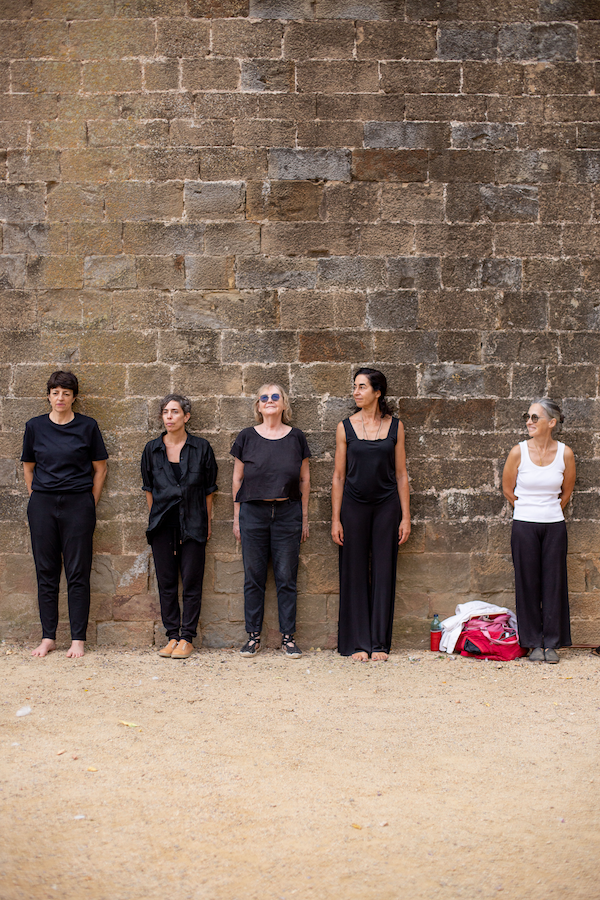
As the members of the public entered the church, the artists are standing in a line. Behind them is one of the group who will fix her eyes on one of the back of one of the artists at a time and try to imagine that she is literally touching that person with their “eyes that touch”. If someone feels that they are being touched they lift their hand. Sometimes they are right sometimes they are wrong.

The audience was invited to participate by asking an important question for our times. Those who wished to ask a question sit one by one at the table where they write down their question on a paper and hide it from sight. One of the artists then sits next to the questioner at the table to write down what they see in the improvisation. The artists then make an improvised reply to each question. Those who feel moved to move take part, those that don’t, remain still. After they have finished, the question is read to the audience and a discussion takes place about how relevant the action was to the question.

Half way through the evening the electricity failed and the audience lit the space with their mobile phones.

The Oracle 2017

The Oracle was presented at Al Jardí in Cadaquès on the 2nd July 2017. The participating artists were: Helen Collard, Marta Vergonyós, Denys Blacker, Nuria Iglesias, Montse Seró, Martine Viale, Sandra Johnston and Mar Serinyá. Photos by Jordi García Moriel.

In The Oracle, the audience were asked to write down a question that was important to them or that they were curious to have an answer for, and to hide the paper from the view of the artists. The artists then began to improvise with objects that they have brought with them. The person who has made the question takes notes and one of the group (who doesn’t know the question ) also takes notes. At the end of the improvisation the texts are read and the audience comment on the content. As usual, the only rule is that the artists can only move when moved by an inner conviction to move and otherwise to remain still.

Ocells al Cap in Cadaquès

We Were Waiting for You 2017

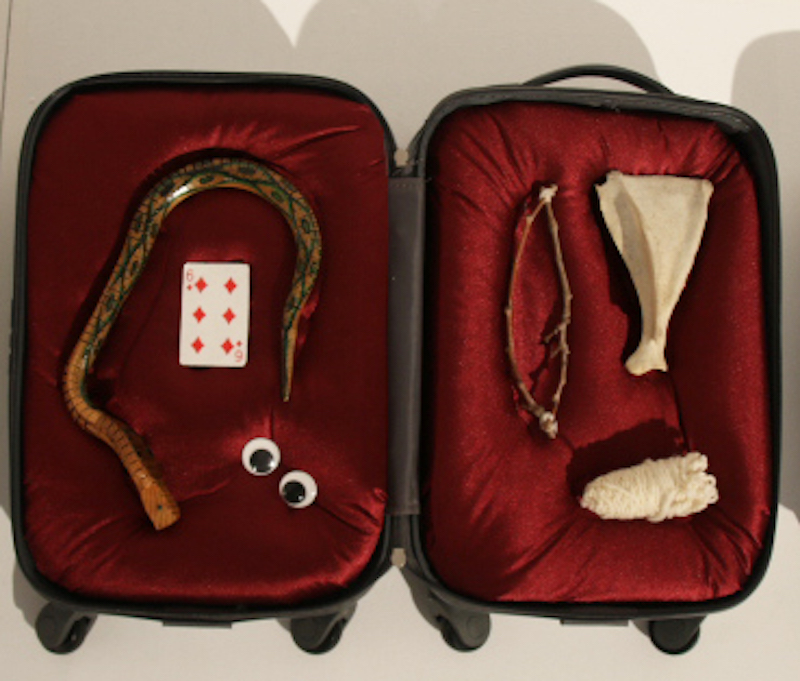
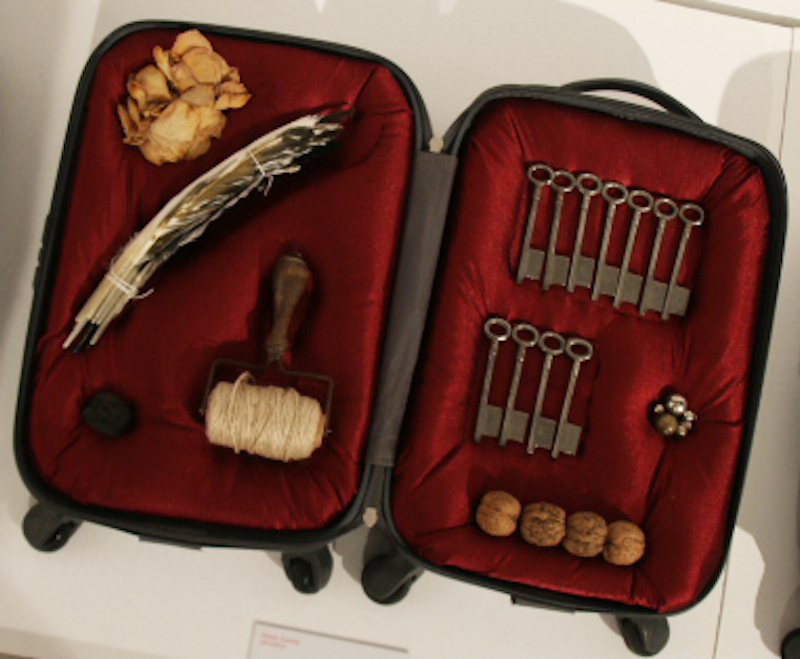
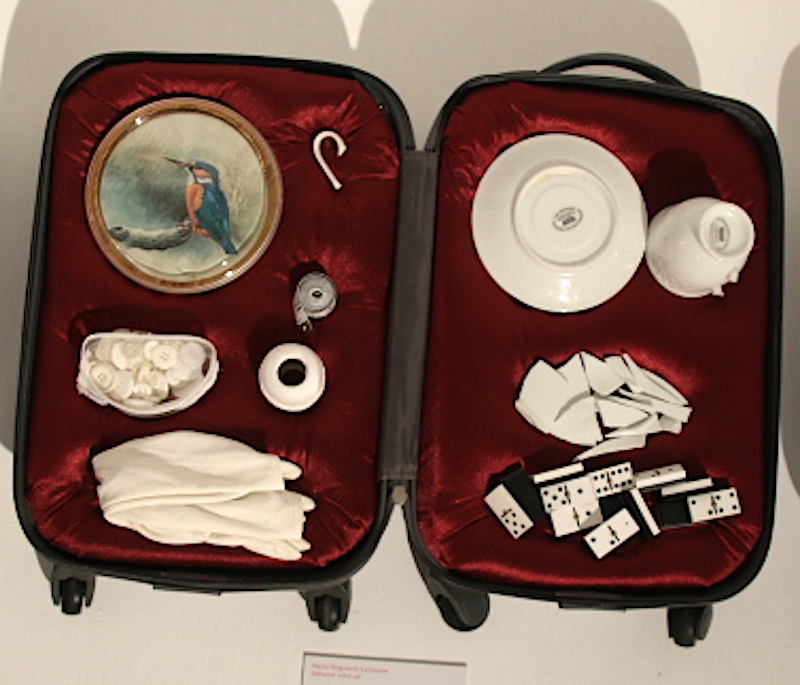
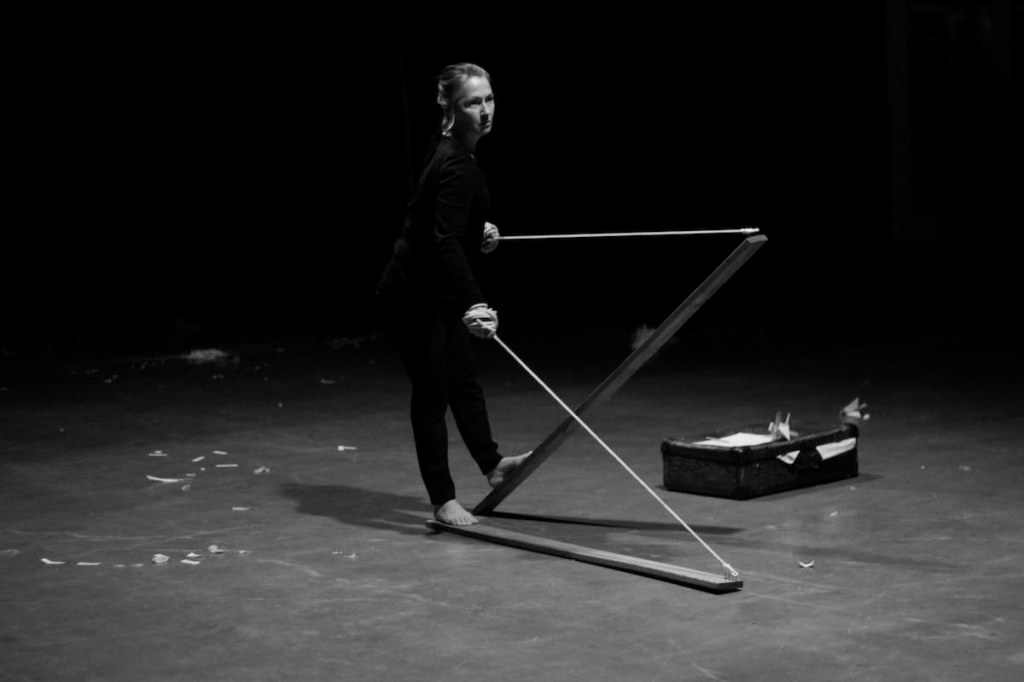
We Were Waiting for You is an experimentation with telepathic communication and was presented at FLARE 3 in Vane Gallery, Newcastle on 4th May 2017. The participating artists were: Denys Blacker, Mireia Zantop, Lesley Yendell, Sabina Vilagut, Marta Vergonyós, Natàlia Espinet, Victoria Gray, Helena Hunter. Photos by Arto Polus.

For the preparation of the performance, each participating artist (5 in Catalonia and 2 in the UK) selected six objects that were packed into cabin-size suitcases to take on the journey to Newcastle. What is in each suitcase is only known by the artist who packed it. The suitcases were later shown along side the photographic documentation at Bòlit Contemporary Art Centre (Girona) as part of the exhibition Denys Blacker – Mapes Efimers; a retrospective show.

We Were Waiting for You, presents the audience with the chance to become involved in a performance, in which relationships can unfold without coercion, by personal choice. Anyone who has a question to ask, may take their place as a silent supplicant or instigator within the process. Their question is written down, but not shown to the performance group. The performance then unfolds in response to this secret question, hidden from view until afterwards and only known to the person who asks it.

Artists without knowing the question, begin to respond through improvised movements and sounds and by taking out and using selected objects from their suitcases. The only rule is that they should not move at all unless they have a strong compulsion to move. It is not a choice, it is a sensation, an intuition. Sometimes all the artists interact, sometimes only a few. Only those who experience the need to participate, participate.

The questioning person sits at a table with a paper and pen to take notes and an artist from the group sits next to them. She will also write. They have to write down everything they observe, without thinking, responding only to what they see unfolding in the performance.

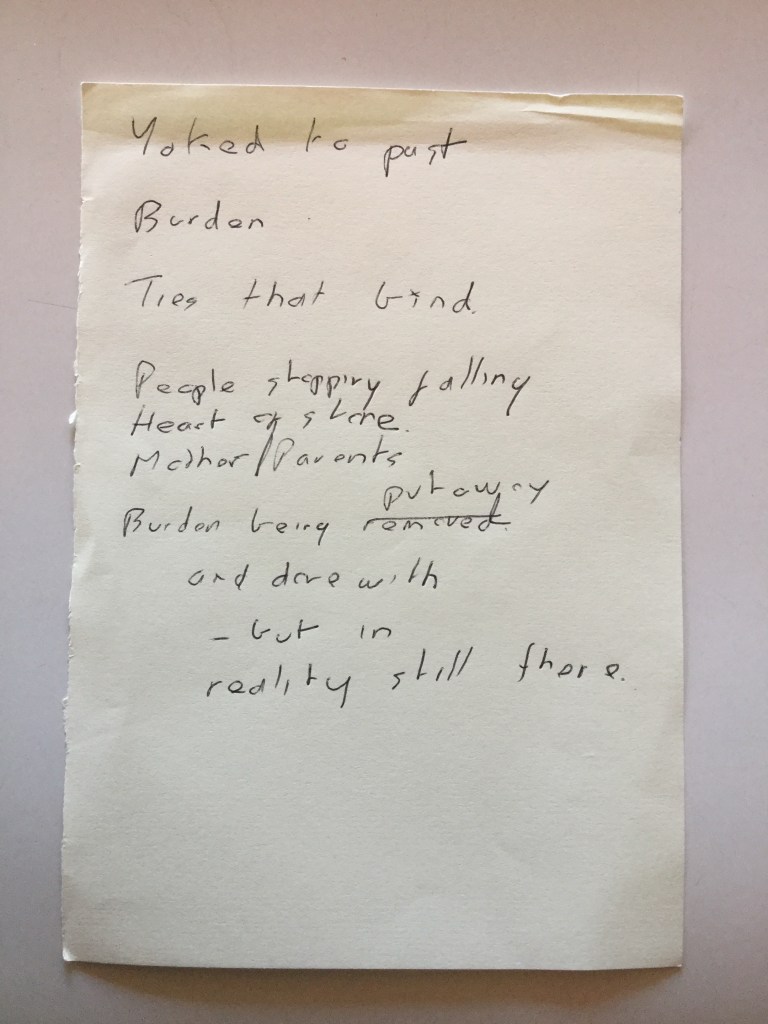
The role of the performance artist as protagonist is transformed by the fact that the content and meaningfulness is given to the work by another person’s vision, formed in the particular question chosen by that person. The questioner take notes, a circumstantial testimonial in a style of writing that, by nature of its immediacy comes close to automatic writing or a stream of consciousness response.  A witness from the performance group makes notes as well, in order to record only what they see. This is later shared with the audience. The question is also shared at the end of the performance if the person who asked it, so wishes. The two texts are read aloud, and a discussion takes place between audience and participants, sharing observations and interpretations of the actions that occurred.

A synchronicity (on the way to Newcastle):

The morning we travelled to Newcastle, we were to meet at the station in Girona to pick up Marta and Sabina. But we had to go early and Marta came late so we went back towards home to pick her up at Celrà where she could leave her car in a free parking space. She needed to swap her suitcase for the silver case we were all using, so we took out the suitcases and began to repack it on the road. When we had finished and had loaded the suitcases back into the car, we were ready to go when we saw that Natàlia and Sabina were crouched over something on the floor. Sabina was closing both her hands around a hopping bird. I went towards her with Marta and saw that it was a swift that had become tangled in a nylon fishing line. Tangled in the line and pressed aginst the back of the live swift was the desiccated body of another bird. Sabina and Natàlia were trying to free it but the bird was struggling and scratching. I picked it up from the floor, pressing down its wings and unexpectedly it dug its extremely sharp claws into my finger drawing blood. Marta too tried to hold on to its tiny body and it dug it claws even deeper into her hand making her shout. With her free hand she grabbed Natàlia’s lighter which was on the floor by her bag, and bunt through the line. It was almost free but the line was tight round its neck and a wing. We were able to free one of its wings wing but the bird struggled loose and flew away. The dessicated skepeton of a bird wrapped in fishing line was left on the pavement. Marta and I compared our puncture wounds and watch the beads of blood ooze out.

We wondered whether the birds were both alive when they were caught in the line? How long had it taken for the decomposition of the dead bird? In the car, Sabina showed us some drawings she had made that day while waiting for us in Girona station, of a bird whose wings are drawn as two hands.
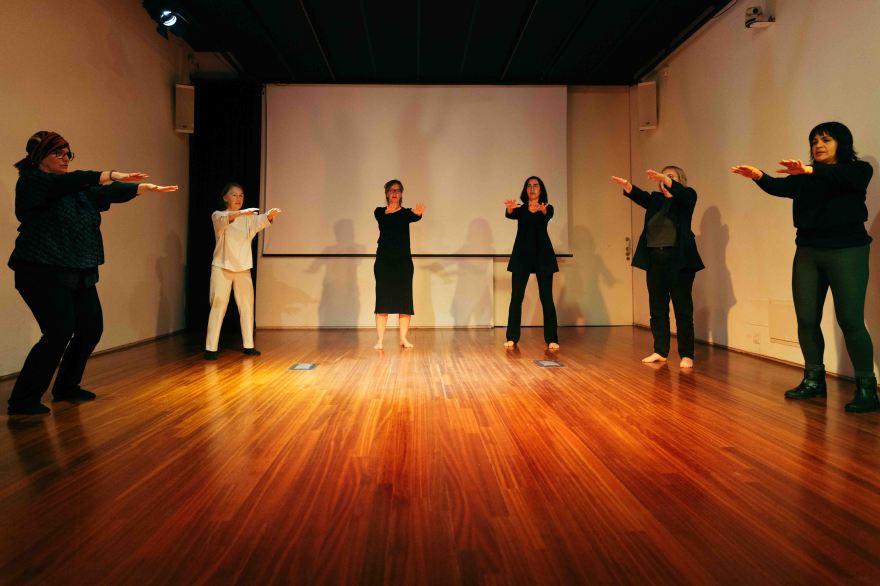
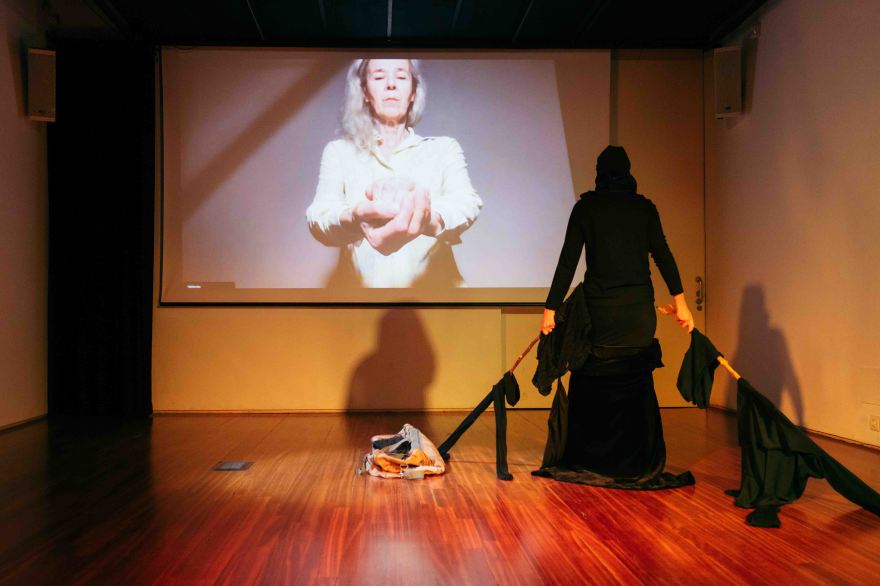
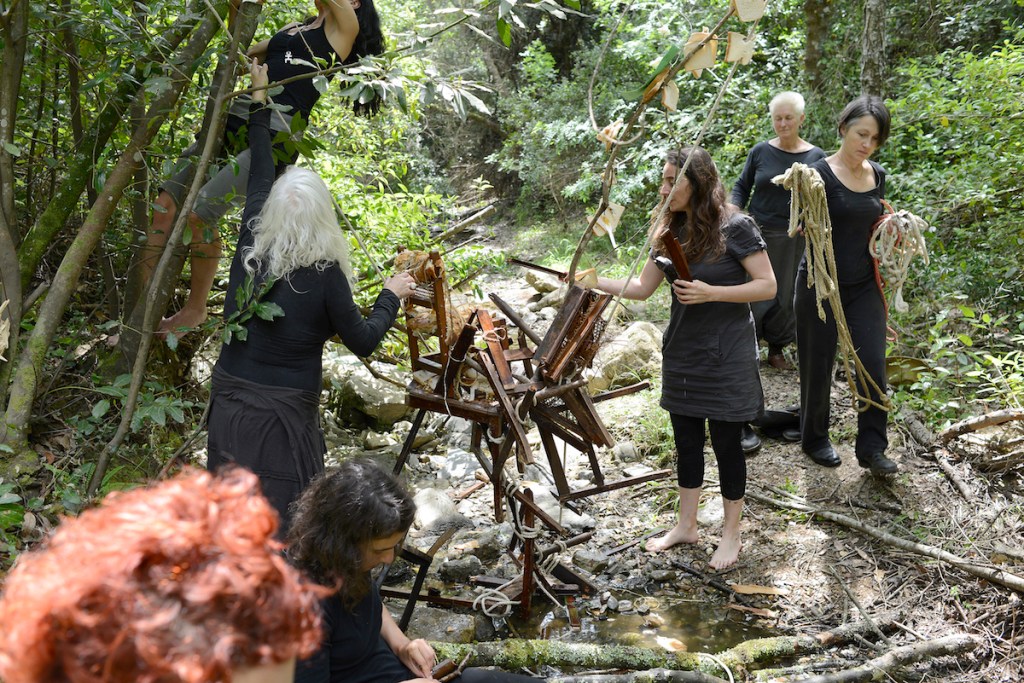
The Sense of Being Stared at 2016

The Sense of Being Stared at was presented on the 19th April 2016 at the  international theatre festival Sismográf in Olot in 2016 as part of a durational collaborative work with the artist Ada Vilaró. In the work, four members of the group (Mireia Zantop, Lesley yendell, Paloma Orts and Denys Blacker), stood with their backs to Vilaró, who was seated at a short distance behind us.
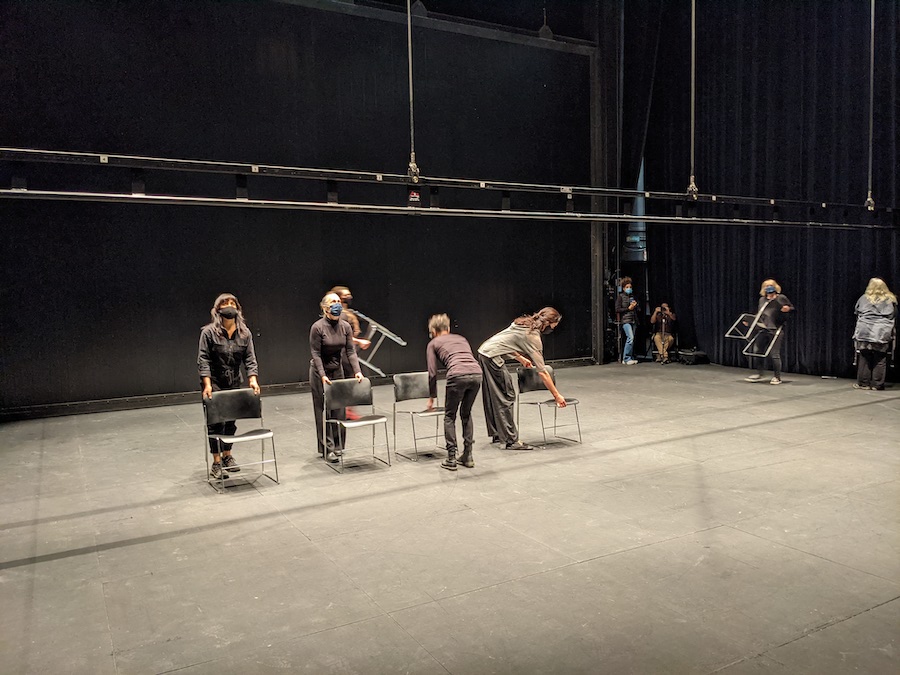
During the two-hour durational work, Ada was instructed to fix her gaze on the back of one of the group at a time for a short duration. This was to be done in silence and with no visual contact with her and the artists. If and when they felt her gaze was fixed on them, they would raise a hand as a sign. She then marked down the times that this coincided with her actually looking at that person. The effect on the audience was mesmeric. The group appeared to be raising and lowering our hands in a choreographed way. From the audience’s point of view, the work was aesthetically pleasing but also hypnotically captivating. some of the people stayed for the full two hours to watch.
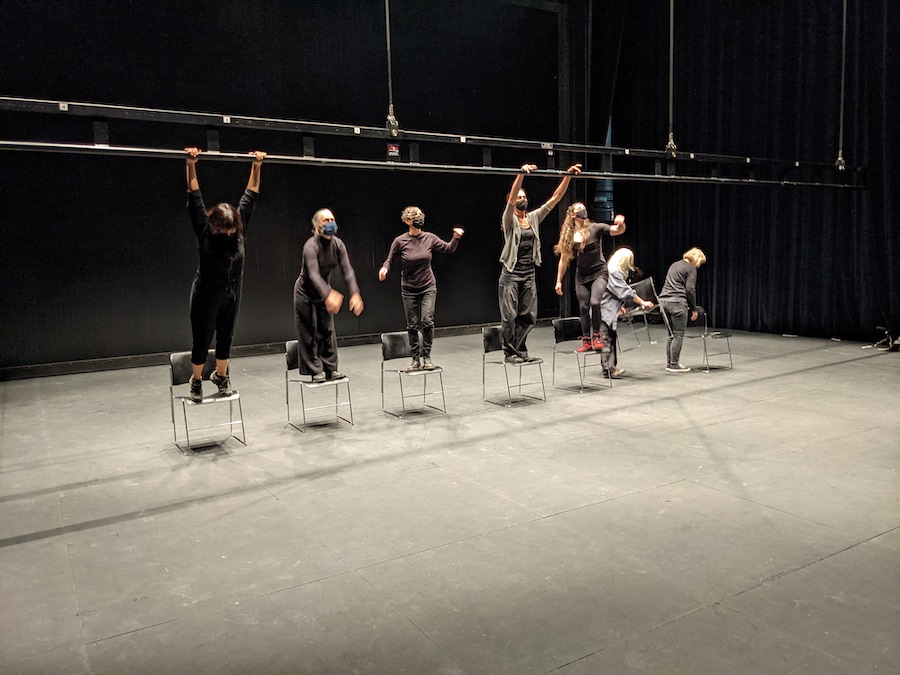
Interestingly, the majority of times that someone raised their hand they were in fact being watched by Ada. this came as a surprise, although they coincided in their experience of, at times, having had a physical sensation of being touched on the back while they were being looked at. There was also a particular moment during the piece when they all lost concentration to such a degree that they began to look at each other. Finally someone turned
to look at Ada, only to find that she had taken a break. They had felt her absence although they hadn’t seen her leave. They may have heard her leave unconsciously, but as the performance was on the street and there were many people walking by that would have been very difficult. Important qualities described by the artists after the performance were; mutual trust, knowing, agreement, confidence, open structure, non-conditional, unifying, political freedom, respect, empathy, determination and practice.

The Sense Of Being Stared At is taken from the title of a book and of an on-going investigation into telepathy, directed by the renowned british biologist Rupert Sheldrake that has been running since the 1980s. Sheldrake has been researching the apparent human ability to know when someone is looking at you even though you don’t have visual contact with that person. Many people have had the experience of feeling that someone is staring at them from behind, and on turning round to check, have been able to verify that indeed someone was looking directly at them. it is also common for the opposite to happen; a person reporting that they have the ability to make another person turn around by staring at them from behind. Sheldrake, in his paper The Sense Of Being Stared At, published in the Journal of Consciousness Studies (JCS), states that in Europe and North America, between 70% and 98% of the people questioned, admitted to having had this experience. This phenomenon now has a scientific name; “scopaesthesia” from the greek word skopein, to look at, and aesthesis, sensation. over the last 30 years or more, Sheldrake has carried out thousands of trials that consistently show significant results to support his claims about this strange human ability.

Even though these experiments have been conducted following rigorous scientific methodology, there is harsh criticism of his research. He has been called a heretic, his work dubbed paranormal and attempts have even been made to discredit the way his experiments are conducted. The American neuroscientist Christof Koch refused to comment on Sheldrake’s paper on the subject, answering the invitation to peer review it in a letter saying, ‘I think it is a waste of time’. Sheldrake’s work has been controversial for many years. In 1981, John Maddox, the editor of Nature magazine titled his review of Sheldrake’s book, ‘A New Science of Life, a book for burning?’.This is a field of research that inspires deep resistance and prejudice. Sheldrake has noted that his most vehement critics are also atheists.

Sceptisism is healthy when the facts are examined beforehand, but many of his critics refuse to even look at the evidence. Why is this so? What is it that makes for such extreme reactions?

Improvisation 2015

This group improvisation was presented at La_Carbonera, Bòlit Contemporary Art Centre in Girona on the 28th November 2015 during the International artists residency organised by FEM International Meeting of Women Performance Artists. The participating artists were: Anet Van de Elzen, Mireia Zantop, Denys Blacker, Harriet Plewis, Natàlia Espinet, Anita Ponton, Ada Vilaró, Mar Serinyá and Montse Seró. The performance was followed by a discussion with the audience.

Pomps of the Subsoil 2015

Performance presented at Festival Escena Poble Nou, Barcelona with Lesley Yendell, Juliette Murphy, Natàlia Espinet, Denys Blacker, Montse Seró y Mireia Zantop. Photos by Claudia Serrahima.

Ocells al Cap met in the hall where they would be performing in Poble Nou, Barcelona. They have each come prepared to make a ninety-minute performance with their own objects and props. The title Pomps of the Subsoil was taken from a painting by the painter Leonora Carrington, chosen because it portrays a group of bird-headed women, but they are not using it as a reference in the work. Each artist has prepared their own individual performance alone, but now we will present them together in the same space. They had no contact or communication between them beforehand about what each one was going to do.

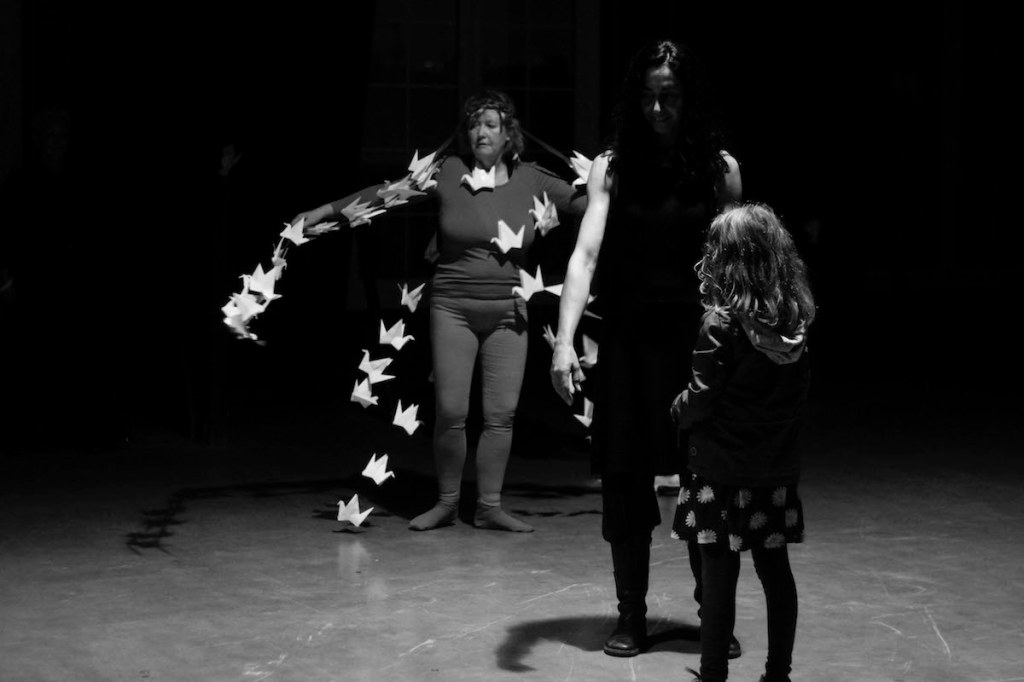
They began working simultaneously, unpacking their bags, while watching each other as an array of objects began to appear in the space. There was an air of positive anticipation, a good feeling. Lesley had brought a tray of small beautifully tied white paper parcels, labelled with the royal names of vegetables. Juliette was covered by a dark blue cloak. Later during the performance when she took it off, we see she was covered in more than eighty small, white origami birds, a dark blue wimple tied to her head by a mass of black ribbon. Mireia took out a white cloth and lay out a row of pale wooden kitchen objects, then a ball of white raffia. She placed a stainless steel bowl full of coins onto a zebra-striped cushion. Montse had brought dried leaves and was wearing blue. She had blue bags full of blue feathers hanging round her neck. Denys had brought white objects and on the floor around her she placed two long, white cloth sleeves, a woven length of white porcelain strips, a white porcelain cone on a red velvet cushion, two planks of wood, a ball of white wool, one white cushion, scissors, a hammer, string and nails. Natalia opened her suitcase and revealed two red notebooks, some pens and a copy of The Poetics of Space by Gaston Bachelard. She had several dresses, red and black. They couldn’t help noticing that the majority of the objects spaced around the room were white or pale. Marta was absent, but she had written an email beforehand. When they read it afterwards, they see that she was planning to bring ‘white offerings for each one; flour for Lesley, salt for Mireia, sugar for Denys, and talcum powder for Madame Juliette’.

One of the objectives of working together is to develop the intra-connections between us. We are hoping to increase the efficacy of nonverbal communication and looking for the possibility of the telepathic transferal of ideas and thoughts. We look for synchronicities in the material and the performances as signs of this happening. Of course it is possible that we will just become more and more familiar with the group aesthetic and end up making a particular kind of work, where we predict with accuracy what the others will do. In whichever case, we are interested to observe how the work of each individual might change over time. We are not trying to prove a pseud-scientific theory, rather to observe and to note the effects of working together as a group on the individual works and on our communication and interaction.

Birds in the Head 2014

The group Ocells al Cap came together for the first time in 2014 when Marta Vergonyós and Denys Blacker were invited by the Fundació Antoni Tàpies (Barcelona) and the Women’s Cultural Centre la Bonne (Barcelona) to make a performance for the exhibition about Allan Kaprow’s work called ‘Otras Maneras‘ curated by Soledad Gutiérrez. They invited a group of women artists to make a reinvention of Allan Kaprow’s work ‘The Birds’, renaming it ‘Birds in the Head’. The participating artists were: Denys Blacker, Mar Serinyá, Marta Vergonyós, Mireia Zantop, Ada Vilaró, Natàlia Espinet, Clara Garí, Paloma Orts, Montse Seró, Nuria Iglesias, Nina Orteu, Lesley Yendell and Sue Blacker.